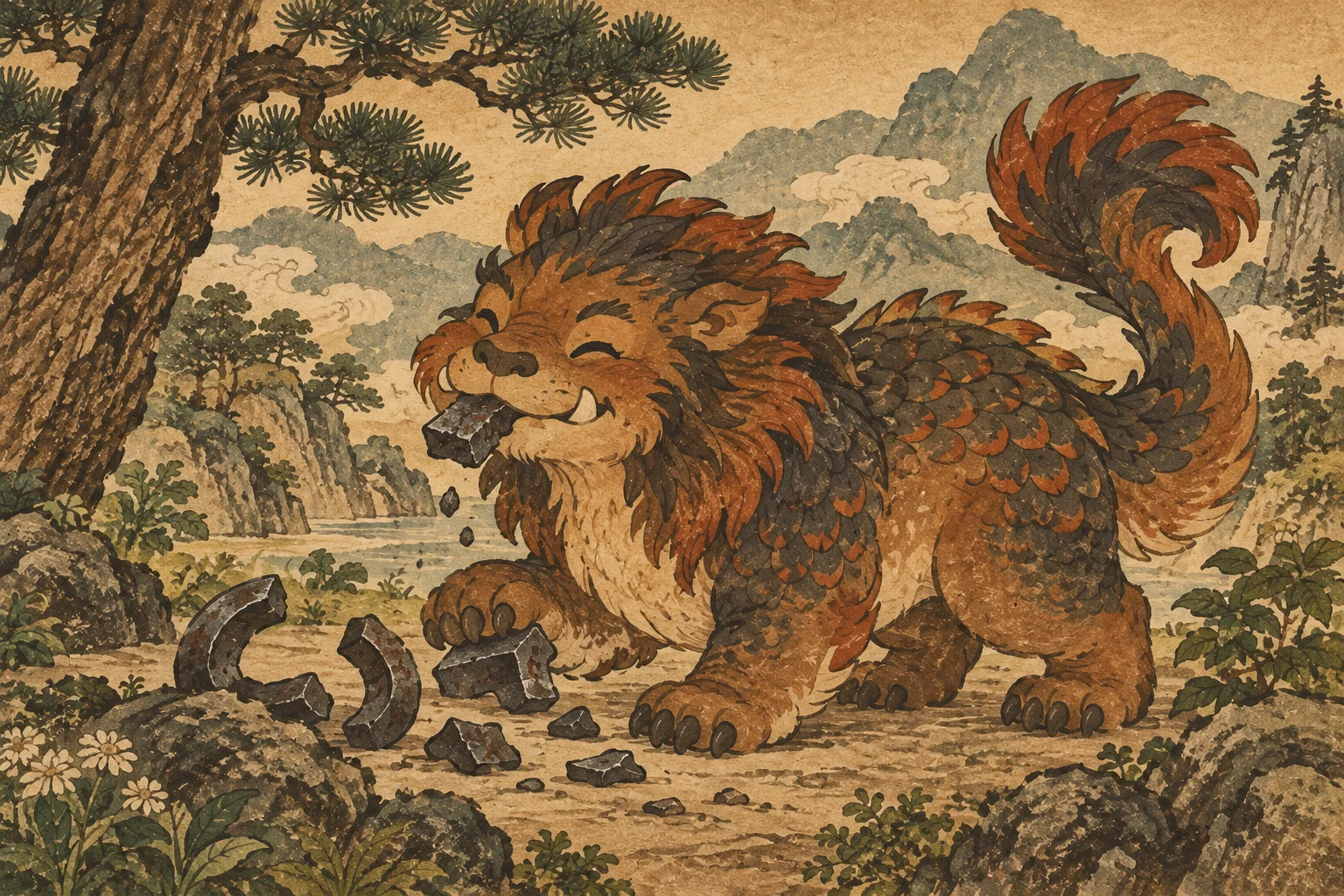
Bulgasari
불가사리
A legendary creature associated with eating iron, known through differing accounts whose details should not be collapsed into one definitive design.
Quick Summary
Bulgasari (불가사리) is commonly associated with iron-eating in Korean legend. Its name and depiction have appeared in different forms, so a modern monster design should not be mistaken for a definitive historical portrait.
The Iron-Eating Motif
The Academy of Korean Studies summarizes oral accounts in which a small animal-shaped object grows as it eats iron. Recorded forms include creatures made in the shape of a pig, ant, mouse, horse, or insect. In many accounts the growing creature becomes impossible to kill by ordinary means; some versions bring it to an end with fire, while others preserve its escape or continued existence. The creature’s origin, maker, size, and ending are not uniform.
The encyclopedia notes nineteen recorded stories in the Korean Oral Literature Encyclopedia. In a number of them, the setting is associated with late Goryeo or Joseon and the plot includes named historical figures or monks. Those frame details belong to individual tellings; they should not be silently combined into a single “original” biography.
Keep Versions Distinct
The name is connected in later explanations with more than one reading, including the “cannot be killed” interpretation and an interpretation connected with killing it by fire. The source presents these as meanings found in transmission, not as a settled etymology that explains every version. Later fiction and films may develop their own creature, plot, and design; those adaptations are not evidence for the appearance of every oral account.
Story Monster and Protective Image
The destructive creature in a tale is not the only recorded role. The Academy of Korean Studies distinguishes the monster of the story from folk uses of its image to ward off disaster and fire. It notes depictions on screens and chimneys, including a relief on the Jagyeongjeon chimney at Gyeongbokgung. This protective use should not be collapsed into the plot, and it does not mean every Bulgasari telling ends with the creature protecting a household. Some versions burn it, while other recorded endings involve a monk’s charm, the creature expelling the iron it swallowed, or its disappearance with the fall of Goryeo.
The same source describes Chinese 貘 (mò; read maek in Korean) traditions as sharing the iron-eating motif while treating the Korean Bulgasari and Chinese figure as separate developments. A resemblance is useful for comparison, but it is not proof of a single origin.
Read the Variants Side by Side
The sources describe several different endings and uses for the Bulgasari image. A single account should be followed on its own terms: the iron-eating monster in a tale and the protective image on a household screen are related motifs, but they are not one continuous story.
Sources
- Academy of Korean Studies, Encyclopedia of Korean Culture: Bulgasari (recorded motifs, variant forms, and the nineteen oral-literature items).
- Academy of Korean Studies, Encyclopedia of Korean Culture: Bulgasari Tales (variant endings, the distinction between tale-monster and protective folk image, and recorded use on screens and chimneys).