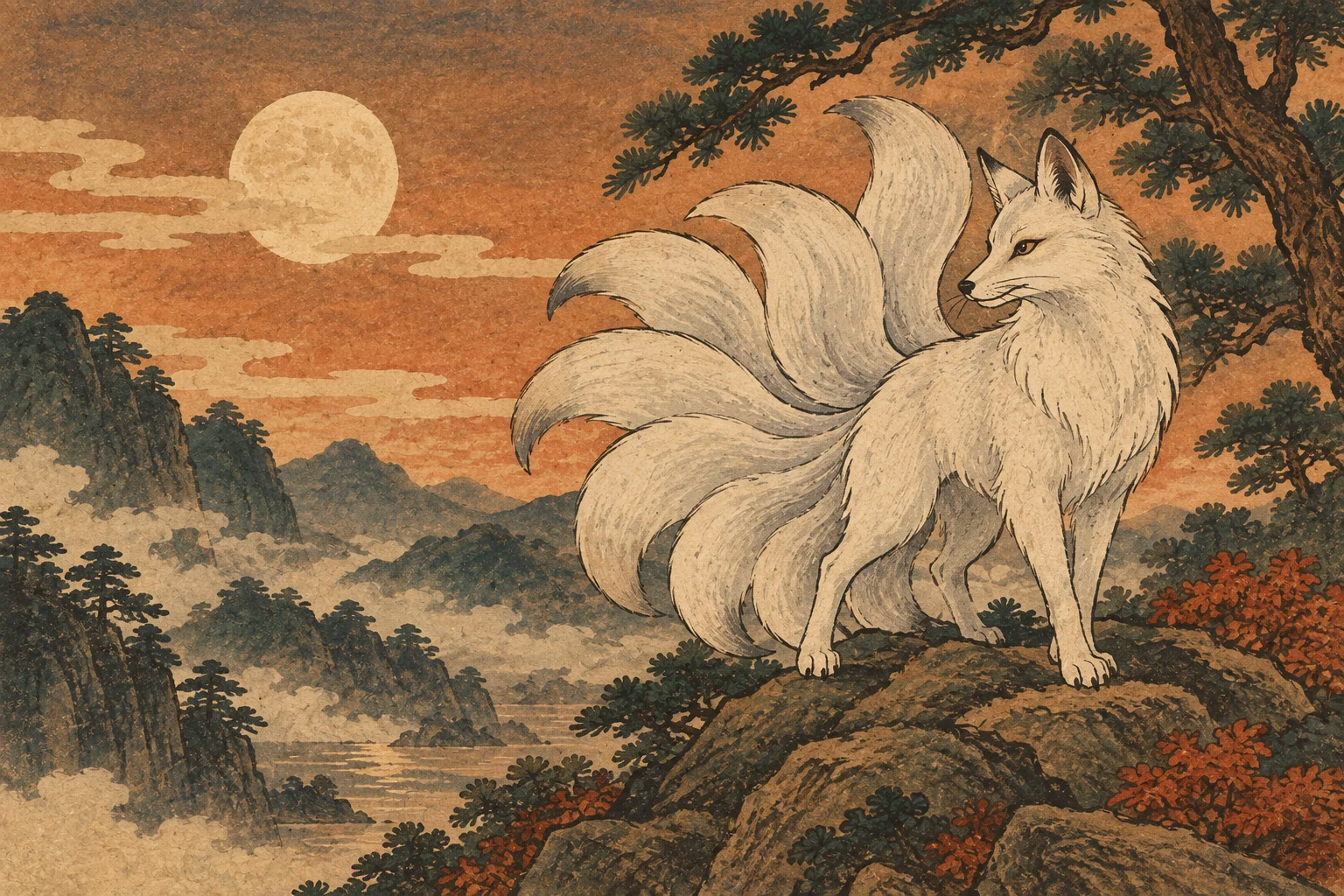
Gumiho: The Korean Nine-Tailed Fox
구미호
Discover what gumiho means, why it is also spelled kumiho, and how Korean fox tales differ from the nine-tailed foxes in modern dramas.
What Does Gumiho Mean?
Gumiho (구미호) means “nine-tailed fox” in Korean. It names a fox-being familiar from Korean folklore and, more recently, television dramas. The name gives you a starting point, but each tale has its own encounter, danger, and ending.
Gumiho or Kumiho?
Gumiho and kumiho are different ways of writing the same Korean word in the Roman alphabet. You may meet either spelling in books, translations, or discussions of Korean dramas; the spelling alone does not identify a different creature.
A Tale Type, Not a Single Biography
The Academy of Korean Studies’ entry Tale of the Fox Bead records two related plot forms. In one, a student discovers that a woman he loves is a fox after she refuses a kiss; he takes the bead from her mouth and gains knowledge according to whether he looks up at the sky or down at the earth. In another, a fox in a woman’s shape visits a school and uses a bead with the students; a teacher helps the surviving student understand the danger. The stories end as an explanation of why human knowledge has limits.
The encyclopedia reports that this tale family is found across the country, with many recorded examples from Hamgyeong, Pyeongan, and Hwanghae. Some versions attach the encounter to a named historical scholar in a particular region. Those local attributions are part of the story’s transmission; they do not turn the supernatural events into verified biography.
Separating Tradition from Modern Media
Popular fiction may present a gumiho as a glamorous woman, a romance lead, or a creature with a stable set of powers. Those are choices made by particular modern works. A traditional story should be described from its own recorded version and location, where known.
Why the Bead Changes the Encounter
In the fox-bead tale, recognizing the visitor is only part of the turn. The small object connects an intimate encounter to a much larger question: what can a person know? A reader expecting only a chase or an exposed disguise may find that the ending is interested in the limits of human understanding.
Try comparing the bead with two objects elsewhere in the Atlas. The dokkaebi’s club makes a material change in a household’s fortune. The Manpasikjeok flute brings relief to a kingdom. The bead’s consequence concerns knowledge. All three objects have extraordinary effects, but possession means something different in each narrative.
Is Every Fox in a Korean Tale a Gumiho?
“Nine-tailed fox” is the meaning of this name, rather than a label for every fox encounter. The fox-bead entry describes a fox-being; its discussion does not establish nine tails in every recorded example. A picture with nine tails can identify a modern gumiho design immediately, while a narrated encounter may reveal its fox through actions or an object instead.
For a first reading, keep three questions apart: what is the being called, how does someone recognize it, and what does the encounter change? That approach leaves room for both an older tale’s unsettling turn and a modern romance’s different use of the fox image.
Sources
- Ministry of Culture, Sports and Tourism, What is a gumiho? (an introduction to the nine-tailed fox and its appearances in modern Korean entertainment).
- Academy of Korean Studies, Encyclopedia of Korean Culture: Tale of the Fox Bead (two plot families, regional distribution, and local historical attributions).