The Goblin’s Magic Club
도깨비방망이
A woodcutter takes shelter in an empty house and finds himself listening to a dokkaebi feast. One crack of a hazelnut changes his fortune—and gives his younger brother an idea.
Story at a Glance
A poor woodcutter goes out for firewood and comes home with treasure. His younger brother wants to repeat the lucky encounter, down to the house and the hazelnuts.
The Story
A woodcutter was troubled by his family’s poverty. He could not see how to earn the money they needed, so he went into the mountain to gather firewood.
As he scraped the ground, a hazelnut rolled out. He picked it up for his father. Another was for his mother. A third would go to his younger brother. When a fourth appeared, he kept that one for himself.
By the time he had finished his work, it was growing dark. On the slope he found a small house with no one inside. He decided to sleep there, but the empty rooms made him uneasy. He climbed into a wall cupboard and stayed hidden.
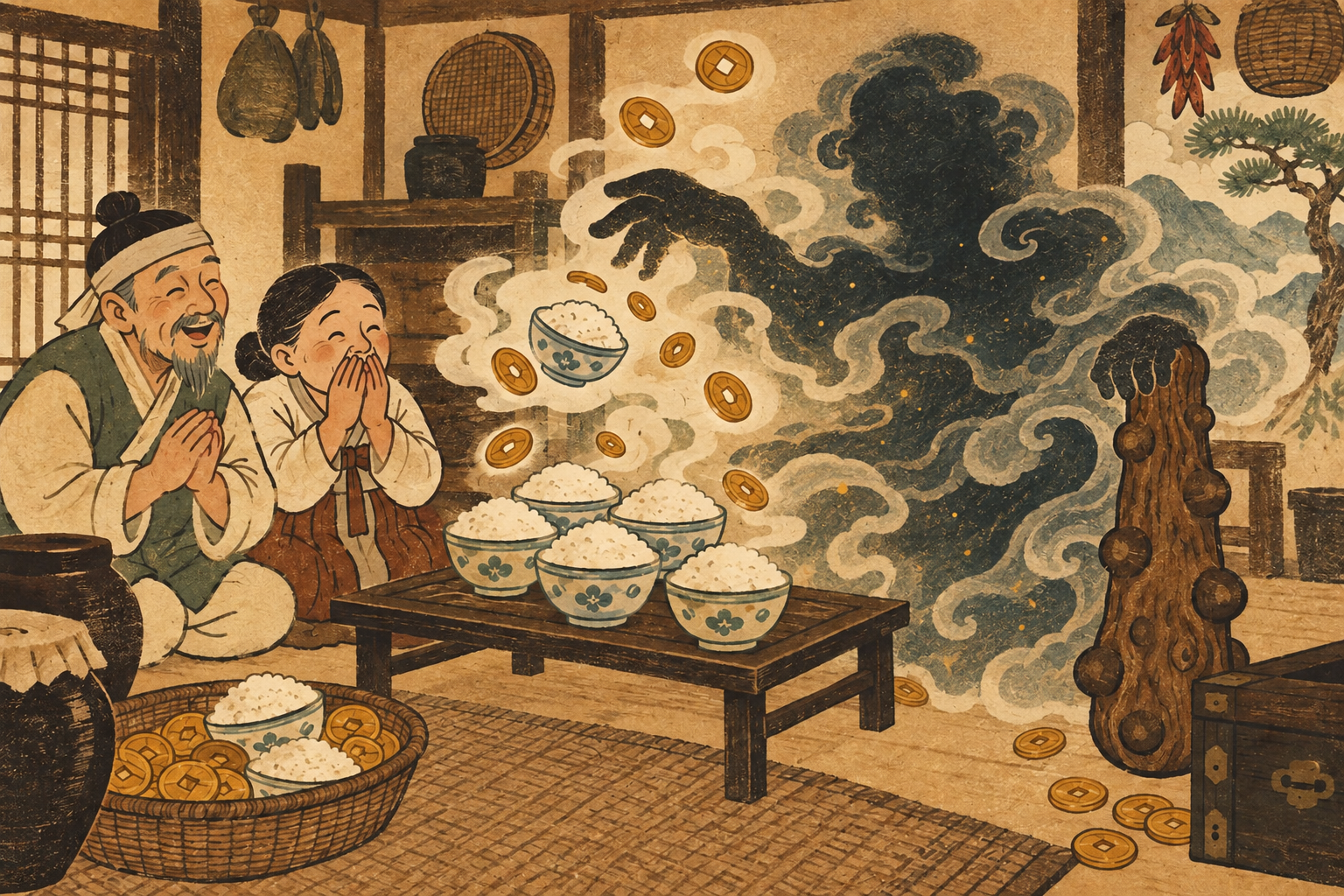
Then the house filled with visitors. Dokkaebi crowded in, carrying their magic clubs. They struck them and called for whatever they wanted.
Silver—thump. Gold—thump. Money—thump. Fruit—thump.
The things appeared, and the dokkaebi went on enjoying themselves. In the cupboard, the woodcutter had only his hazelnuts. He put one between his teeth and bit down.
Crack!
The dokkaebi stopped at the sound. They thought the house’s great roof beam was breaking. In a panic they fled, leaving behind their gold and silver clubs, their money, and their fruit.
The woodcutter came out of the cupboard. The empty house was now full of things he could take home. He threw aside his firewood, gathered the treasure, and set off with a very different load from the one he had expected to carry.
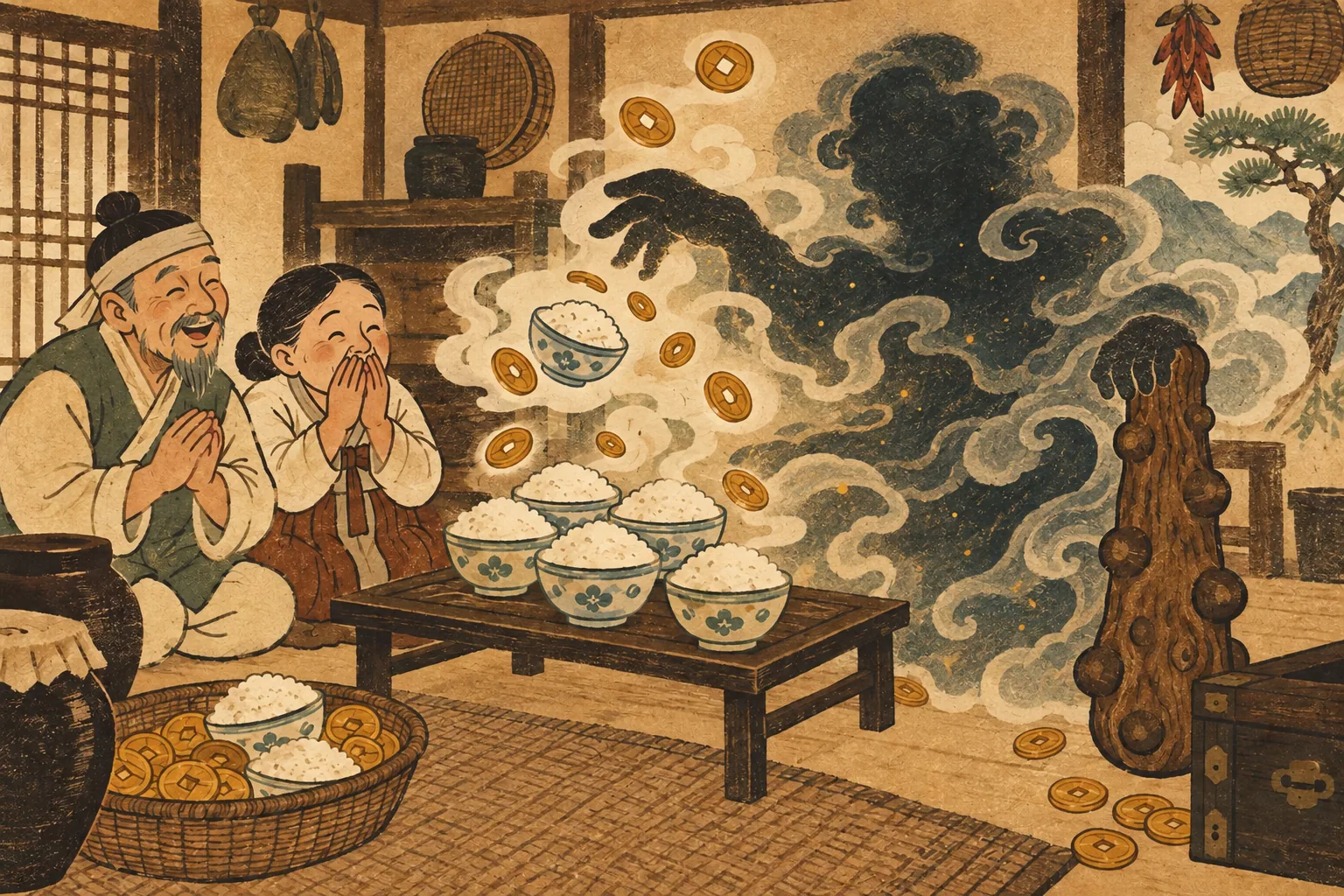
As soon as he could see his home, he began calling to his parents. His mother came out to find him staggering along with his burden. He told her about the house, the dokkaebi, and everything they had abandoned. The poor household had become rich overnight.
His younger brother wanted to know how it had happened. The elder explained the encounter and told him what to do. If he followed the instructions, the younger man expected to be rich by the next day too.
He went to the mountain and scraped the ground. When a hazelnut rolled out, he kept it for himself. The next was for his brother, the next for his mother, and the last for his father. He had gathered the same nuts, but thought of himself first.
At dark he found the house and climbed into the cupboard. The dokkaebi returned and began calling for gold and silver as before. This time they were ready to look for the visitor who had frightened them the previous night.
They threw open the cupboard. There was the younger brother, caught in the hiding place where he had expected to make his fortune.
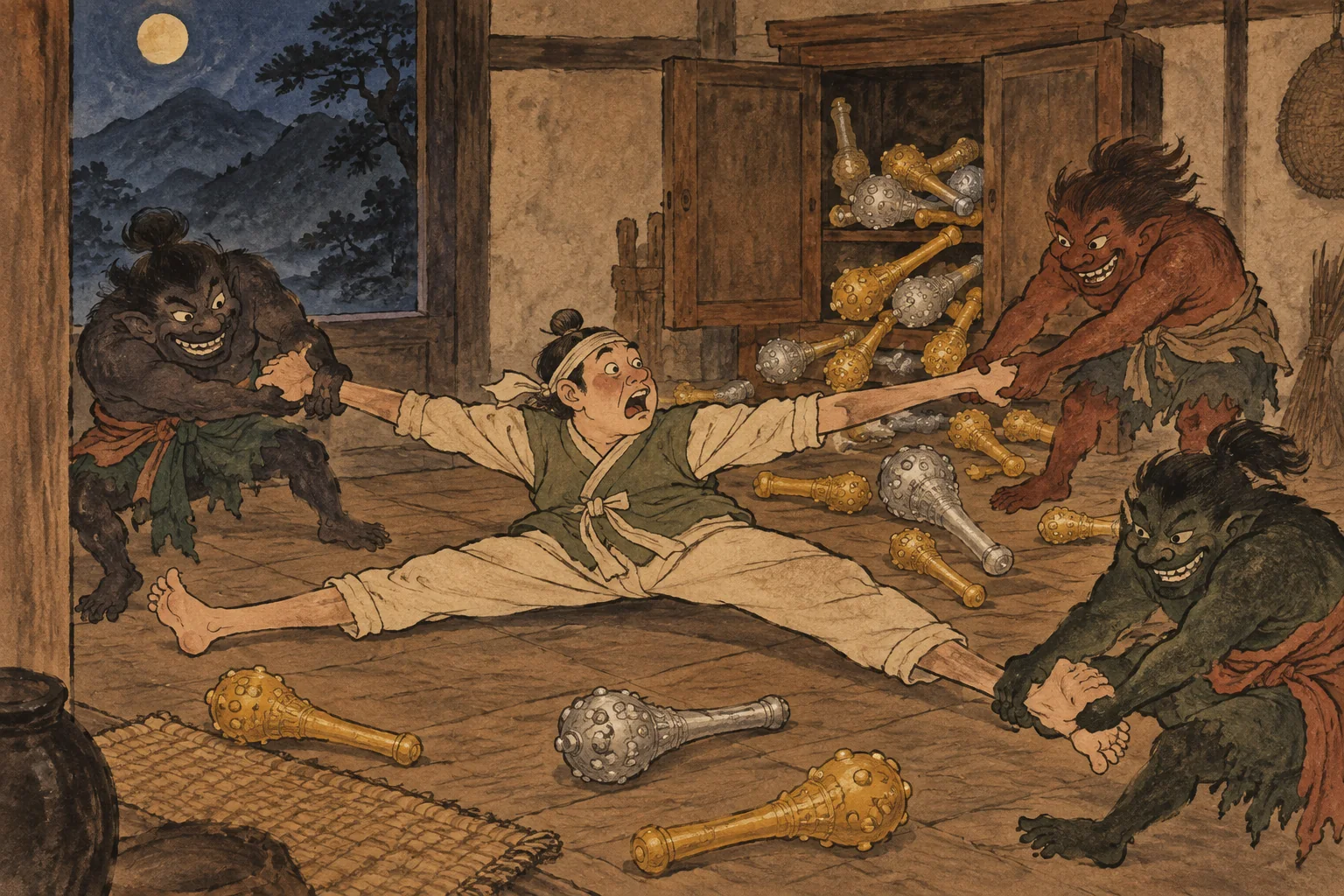
They dragged him down and pulled his arms and legs. With each command and strike of a club, his limbs grew longer. He could do nothing to stop them. When dawn came and the dokkaebi left, he struggled home, dragging his stretched limbs behind him.
His parents had expected another load of treasure. Instead, they had to care for a son who could scarcely move. Becoming rich had seemed so easy the night before. Now the family spent money trying to have him cured.
Korean Context in This Story
The chant of the magic club—asking for gold or silver with each ttukttak, or thump—is a memorable part of Korean children’s storytelling. Dokkaebi tales often let an ordinary person stumble into wonders and comedy. Here the tiny hazelnut sound is mistaken for a collapsing roof, and the attempt to repeat a lucky accident gives the second half its turn. Thinking of parents before oneself also reflects the family values emphasized in many tellings. Meet the dokkaebi →
A Closer Look
Can a lucky accident happen twice?
The first woodcutter does not set out to steal from dokkaebi. He is working, saving nuts for his family, and looking for shelter. His hiding place lets him witness the feast, but the visitors’ mistaken explanation of a crack is what gives him the treasure. The story allows an ordinary appetite to cause an extraordinary escape.
His brother retraces the route as though every part of that accident can be arranged again. The order in which he sets aside the nuts also changes: he puts himself first. Meanwhile, the dokkaebi have acquired something he fails to allow for—experience. They return prepared to search the cupboard. The house may be the same, but its visitors no longer are.
The cost of his punishment reaches the whole household. His family expects treasure and instead has to spend money on his treatment. The repeated journey therefore changes more than one man’s fortune.
Read next: Heungbu and Nolbu gives imitation a different mechanism: a brother deliberately creates the need for a good deed. In this dokkaebi telling, the lucky brother is older; in Heungbu’s story, he is younger.
Versions and Sources
Read about this telling and other versions
This story follows Oh Su-yeong’s 1982 Yongin recording of “Dokkaebi Club”. It keeps the four hazelnuts, the cupboard, the treasure left behind, and the younger brother’s stretched limbs and treatment expenses. The transcript does not explicitly repeat the nut-cracking action in the second encounter, so that action is not added here. Other retellings use a jealous neighbor and a beating instead of the brother and this punishment.