Dokkaebi
도깨비
A familiar but varied supernatural figure in Korean tales, often encountered through a particular story rather than a single fixed portrait.
Research note · see sources and scope belowQuick Summary
Dokkaebi (도깨비) is the Korean name for a supernatural figure found in many recorded tales. A single English label such as “goblin” can be useful for orientation, but it does not capture every version.
What the Name Can and Cannot Tell Us
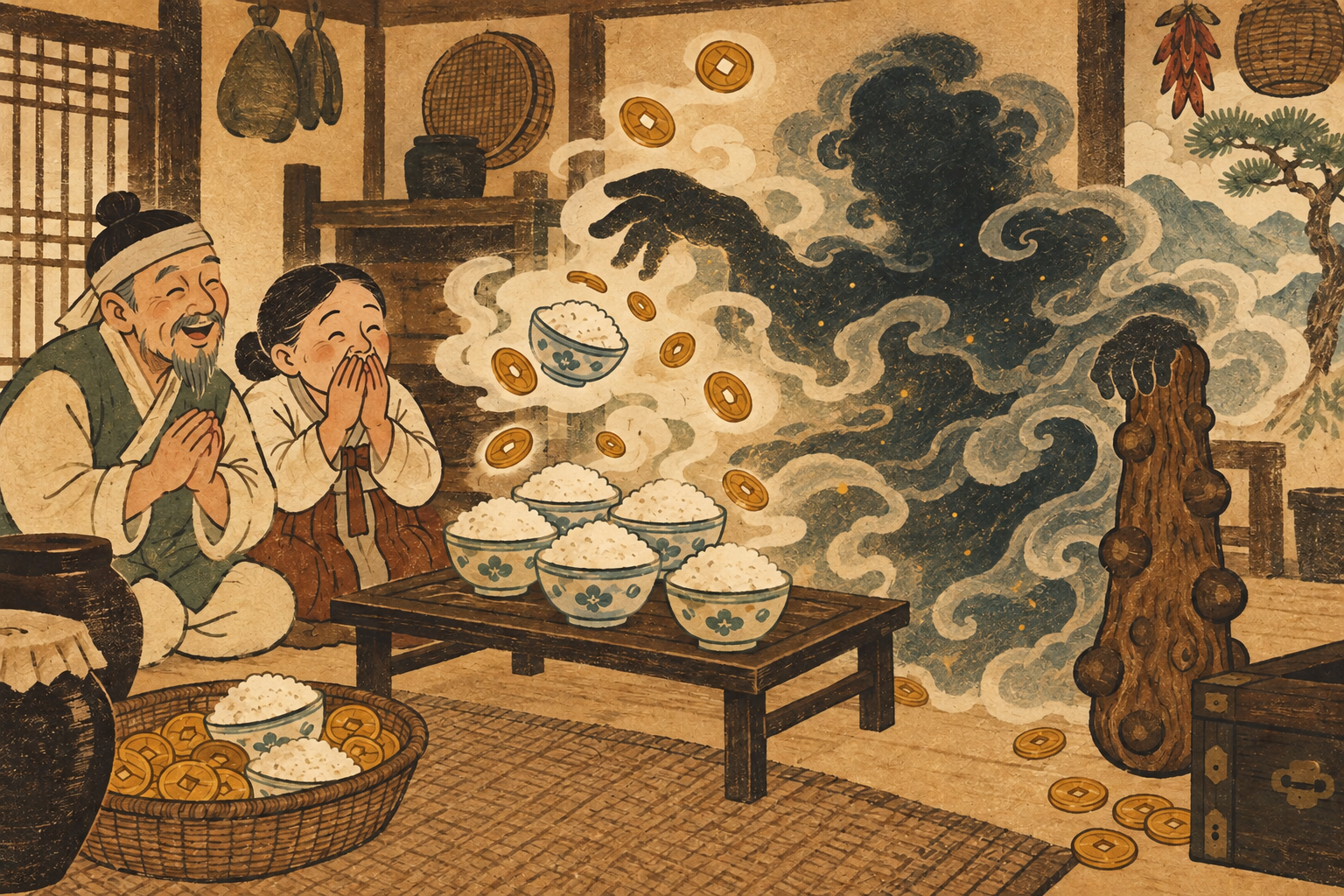
Stories give dokkaebi different roles and qualities. In The Goblin’s Magic Club, the being is part of a plot about a magical object and unexpected fortune. That one episode is not a complete catalogue of dokkaebi beliefs.
The word is often translated as “goblin” in English-language retellings. Treat that as a loose translation, not proof that dokkaebi and European goblins share the same origin, appearance, or rules.
Story-Specific Detail
The linked retelling follows one tale recorded in a Korean folklore reference. Its club and events belong to that telling. Modern media designs—including familiar horned or red-faced versions—should not be projected onto every traditional account.
Reading with Care
When comparing stories, ask what the dokkaebi does in that particular version: offers a challenge, causes trouble, grants a reward, or appears in another role. Do not turn one motif into an all-purpose supernatural rule.
More Than a Magical Club
The Academy of Korean Studies groups several different dokkaebi narratives: a magical object brings wealth, a character wins a contest, a traveller wrestles an apparent giant, or a place receives an origin story. The creature can help, hinder, or be fooled. Those patterns make it hard to reduce dokkaebi to a single “Korean goblin” character.
The paired-gourd or “imitate the fortunate person” pattern in some club stories also matters. A later character copies a successful act but receives a bad outcome. The point is the contrast between the two characters’ choices, not a universal rule that every dokkaebi rewards virtue or punishes greed.
The Horned Image Is Not a Rule
Older and modern depictions differ, and an illustration attached to one story should not be used as a reference for every account. In this Atlas, the club belongs to the selected story version; red skin, horns, a particular costume, and other familiar screen details are not treated as fixed folklore traits.
Sources
- Academy of Korean Studies, Encyclopedia of Korean Culture: Dokkaebi Folktales (narrative families and recurring motifs).
- Academy of Korean Studies, Encyclopedia of Korean Culture: Dokkaebi’s Magic Club Tale (the specific story tradition retold here).
- The encyclopedia is a research starting point; this page is an original summary, not a reproduced translation. Individual entries and images may have separate rights terms.