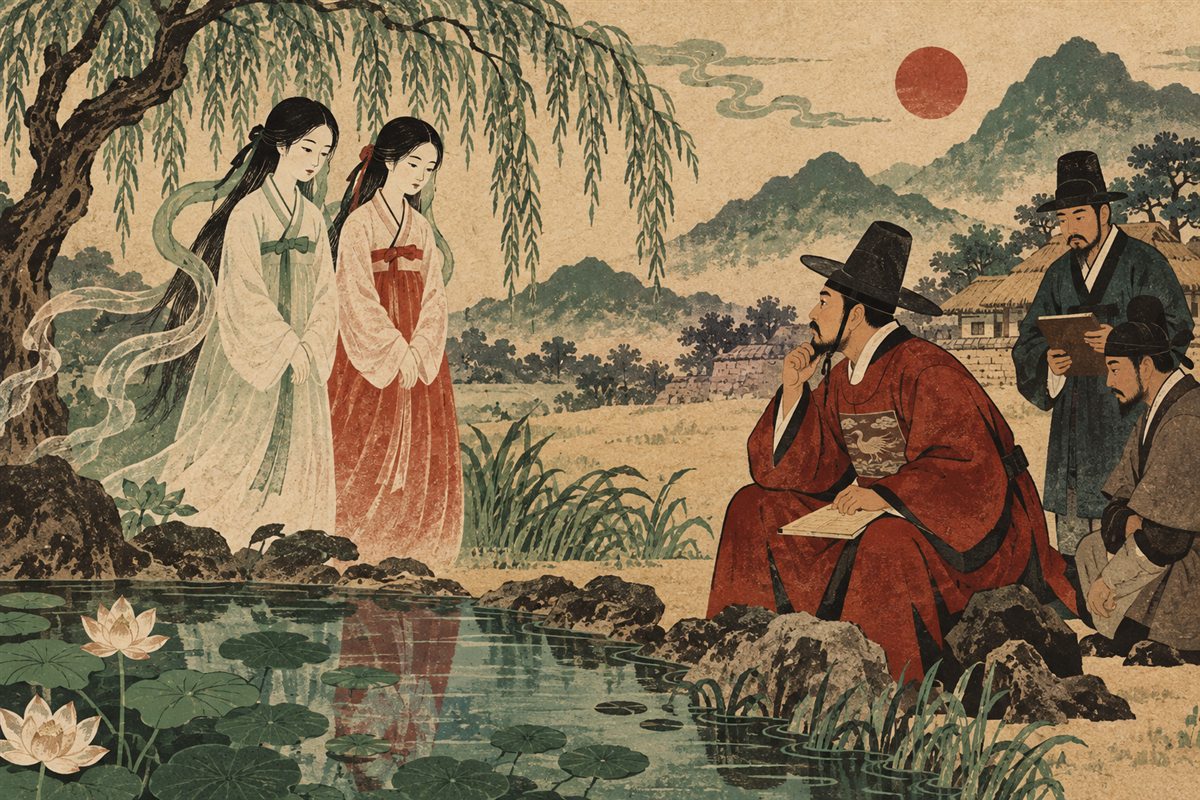
Janghwa and Hongryeon
장화홍련전
Two sisters are betrayed inside their own household, return as ghosts to demand a hearing, and force a magistrate to test the evidence.
Story at a Glance
In the Hangul version summarized here, Janghwa and Hongryeon lose their mother while they are young. Their father remarries, and their stepmother’s lies turn the family against them. The sisters die without being believed. When a new magistrate finally listens to their ghosts, he must decide whether to accept a convenient story or examine the evidence.
The Folktale — Faithfully Retold
In the reign of King Sejong, Bae Muryong, a local official in Cheolsan, had two daughters, Janghwa and Hongryeon. Their mother died when Hongryeon was five. Their father married another woman, Heo, who later had three sons of her own. Once she had children in the household, Heo began to mistreat her stepdaughters.
Janghwa became engaged. Her father spoke of preparing a generous marriage chest. Heo did not want the family’s wealth spent on Janghwa, and she devised a way to turn the household against the girl. She caught a large rat, removed its fur, and placed it in Janghwa’s bedding. She showed the grisly object to Muryong and claimed it proved Janghwa had become pregnant outside marriage and lost the child.
Muryong believed the accusation. Heo told her son Jangsoe to take Janghwa away at night and kill her. As Jangsoe led the girl toward a pond, a tiger attacked him. He survived maimed; Janghwa did not return. Heo then treated Hongryeon with even greater cruelty. Hongryeon learned what had happened to her sister, and after Janghwa appeared to her in a dream and told her the truth, she went to the pond and died there too.
The pond became a place of grief. The sisters’ ghosts tried to tell their story to the district magistrates, but each official was so frightened by their appearance that he died. The post remained unwanted until Jeong Dong-u volunteered to take it. On his first night, the two sisters appeared and asked him to clear their names.
Jeong questioned their father and stepmother. Heo repeated her accusation and presented the object she called evidence. At first the magistrate released the couple. That night, the sisters returned in a dream and told him to look inside the supposed remains. He cut it open. What Heo had called proof was only the rat she had used to frame Janghwa.
The magistrate reopened the case. Heo was executed, Jangsoe was hanged, and Muryong was released. Jeong recovered the sisters’ bodies from the pond, buried them, and set up a marker to honor them. The ghosts returned once more, this time to thank the person who had finally listened. The scholarly summary also says Jeong later rose to high office.
Korean Context in This Story
Janghwa Hongryeonjeon is both a family-conflict narrative and a case-solving tale. Here the magistrate’s inquiry turns on whether he will question the object offered as evidence. The scholarly entry lists several endings across the textual tradition, including execution, punishment in the underworld, the sisters’ return to life, and rebirth as twins. This retelling follows the selected Hangul plot summary and does not attach an ending from another textual family to it.
Versions and Sources
Source basis: “Janghwa Hongryeonjeon,” Academy of Korean Studies Encyclopedia of Korean Culture, a scholarly plot summary of a Hangul version. It identifies the father as Bae Muryong, Hongryeon as five when her mother dies, and the magistrate as Jeong Dong-u. The summary was checked for these names, the evidence test, the sisters’ deaths, the resolution, and Jeong’s promotion. The encyclopedia distinguishes four ending families; this retelling follows the Hangul plot summary without borrowing an ending from a different family. It is not a primary-text collation or a translation of a complete edition. The National Library of Korea also holds a digitized 1923 Hong Sun-pil print, a distinct witness.
Retold in original English prose.
Source and plot checked 2026-10-04. See the source note for whether the basis is a primary text, oral record, or scholarly summary.