Kongjwi and Patjwi
콩쥐팥쥐
Kongjwi completes a stepmother’s impossible chores with unexpected help, but Patjwi pushes her into a stream. The 1982 teller recalls a flower and Kongjwi’s revenge, then hesitates over the ending.
Story at a Glance
In this 1982 oral telling, Kongjwi’s stepmother assigns her impossible chores before a village feast. Animals and an old woman help her. On the way home, Patjwi pushes her from a narrow bridge into the stream. The teller remembers a flower and Kongjwi’s revenge, then hesitates while trying to recall how the search ended.
The Folktale — Faithfully Retold
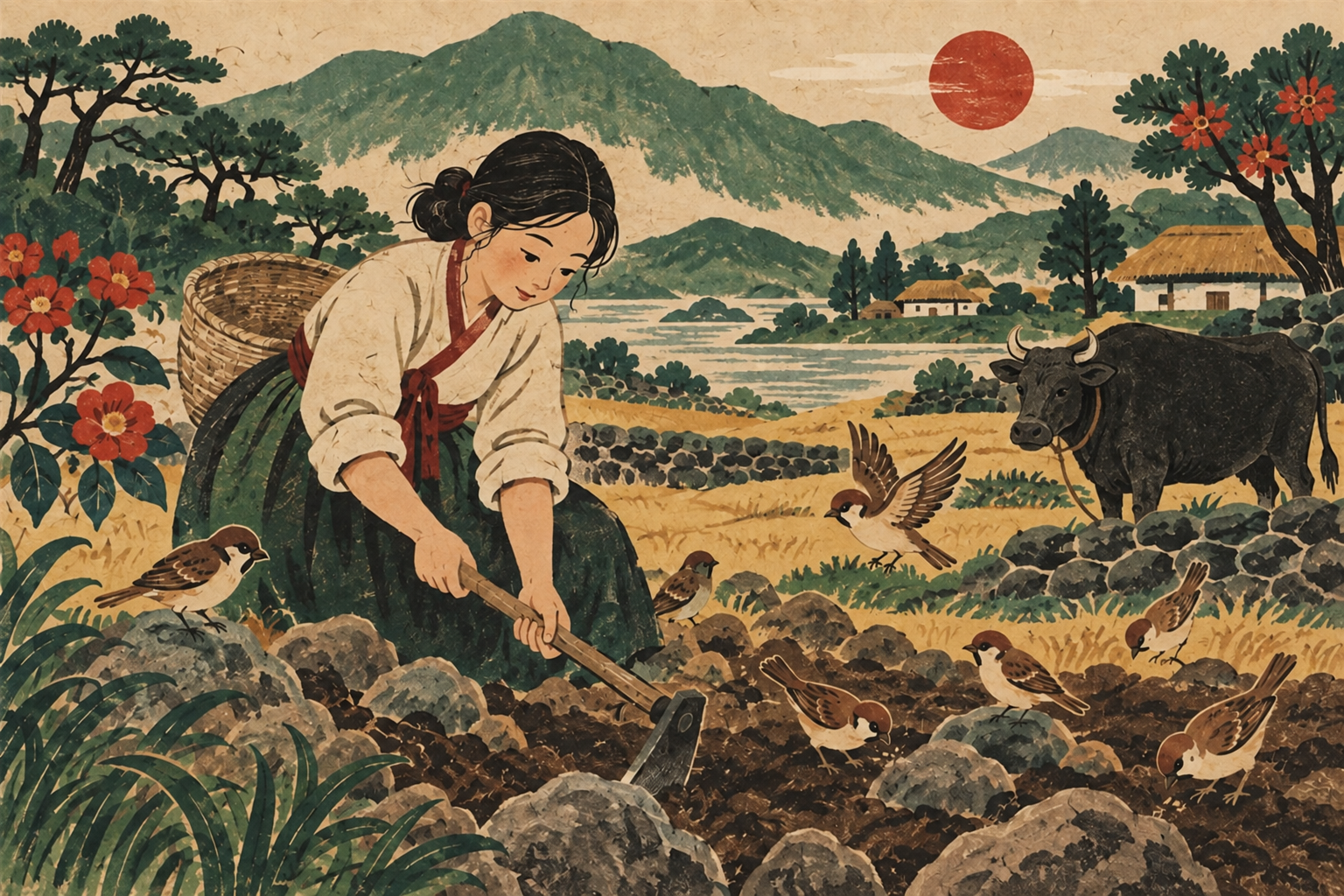
The selected recording was made in 1982 in Idong-myeon, Yongin. Oh Su-yeong calls the girls Kongnye and Papnye in places. After Kongjwi’s mother dies, her father remarries; the new wife brings Patjwi and mistreats her stepdaughter. At the first chore, Patjwi gets an iron hoe for sandy soil while Kongjwi gets a stick hoe for stony ground. Kongjwi weeps when the tool breaks. A black cow comes down from heaven, hoes the field, and gives her fruit to eat.
Before the feast, the stepmother orders Kongjwi to fill a bottomless water jar, pound three seom of hemp, fill a bottomless mortar, and cook rice in a leaking pot. Birds pound the hemp. A toad stops the water leak. An old woman tells Kongjwi to put a leafy stem under the pot to stop the rice escaping. When the tasks are done, the old woman directs her to a chest with bright clothes and flower-patterned shoes. She goes to the feast.
Patjwi and her mother have already returned from the feast when they meet Kongjwi on a narrow one-log bridge. Jealous of her clothes and shoes, Patjwi insists Kongjwi walk ahead, then pushes her into the water. Kongjwi drowns. Her father hears what happened and demands that they find her.
Patjwi admits that she pushed Kongjwi into the stream. Her father and Patjwi go to the bridge to search. A bright flower has appeared in the water. Patjwi reaches for it and disappears; only a hand holding the flower can be seen. When they try to retrieve it, the teller says Kongjwi’s ghost is holding the flower and wearing the red clothes Patjwi took. She says Kongjwi has avenged herself, then admits she cannot remember the ending clearly and tries to reconstruct the search. The recording ends with that uncertainty, without a settled account of what follows.
The 1982 teller’s account after the flower is hesitant and self-correcting: she first says both sisters were pulled under, then describes only Kongjwi’s hand and clothes appearing with the flower. The retelling preserves that uncertainty. No marriage, impostor at a magistrate’s home, bead, execution, or reconciliation is added. Those occur in other Kongjwi and Patjwi versions.
Korean Context in This Story
The Academy of Korean Studies describes the tale in two broad movements: Kongjwi’s marriage, followed by death and return. Many short adaptations stop at the shoe and wedding, leaving out the pond, the flower, the bead, and the recognition scene. Helpers, tasks, names, and exact ending details vary among recorded tellings.
Versions and Sources
Selected recording: Korean Oral Literature Compendium, POKS.GUBI.GUBI.1_20663, told by Oh Su-yeong (68) in Idong-myeon, Yongin, on 23 January 1982. The metadata says she re-told it after stopping on a prior visit because she forgot the story; at the end of this recording, she again says she cannot recall the ending. The retelling stops at that same boundary. The wedding, magistrate, bead, and punishment ending belong to other variants and are excluded here.
Retold in original English prose.
Source and plot checked 2026-10-04. See the source note for whether the basis is a primary text, oral record, or scholarly summary.