Kongjwi: Beyond the Cinderella Comparison
콩쥐팥쥐
A lost shoe is only one part of Kongjwi's story. Follow the impossible chores, the second recognition, and the return that some childhood versions leave out.
A Familiar Doorway into a Longer Story
“Korean Cinderella” is a useful first introduction to Kongjwi and Patjwi. An unfair household, unexpected help, and a lost shoe give a new reader something familiar to hold onto. But try reading onward without expecting the marriage to settle everything. In the telling here, finding a husband does not make Kongjwi safe.
The Academy of Korean Studies describes both a marriage sequence and a later death-and-return sequence. It also notes that children’s adaptations have often omitted the latter. Readers remembering different endings may therefore be remembering different books, rather than misremembering the same story.
Look at the Tools Before Judging the Effort
Patjwi receives an iron hoe; Kongjwi receives a wooden one. The unfairness is built into the equipment before either girl begins. Later, the water jar leaks no matter how often Kongjwi fills it. These are useful details to keep in view: working harder cannot repair the conditions of the task.
Each helper changes those conditions. The cow can turn the earth, the toad closes the hole, and the birds finish the grain. Read the sequence by asking what each arrival makes possible. The wonder becomes easier to follow when every intervention answers a particular problem.
Two Ways of Recognizing a Woman
The shoe leads the magistrate to Kongjwi. Later, her clothes let Patjwi impersonate her. Read side by side, those two events make a possession an uncertain guide to identity: a shoe helps someone find its owner, while a stolen outfit helps conceal a murder.
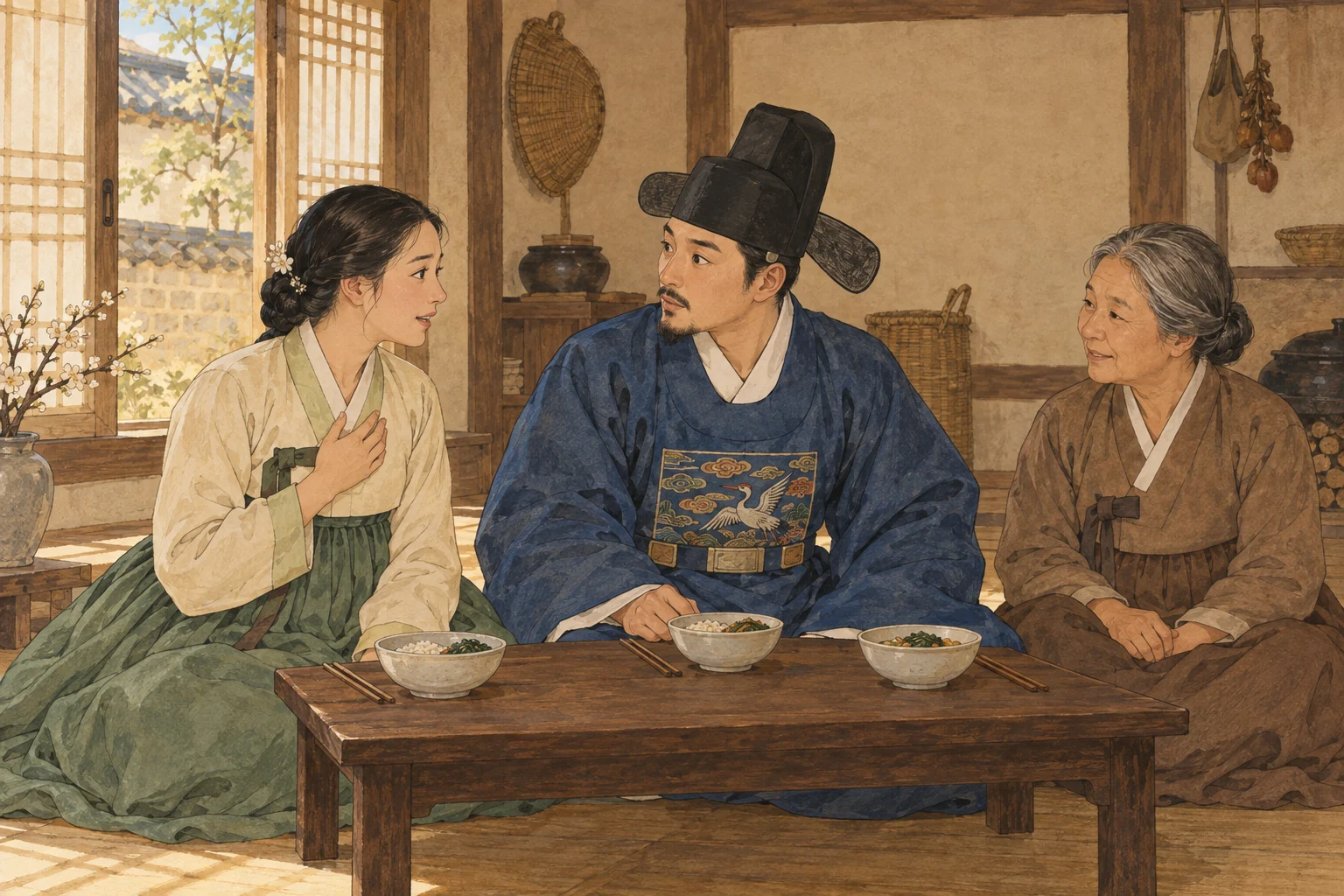
At the old woman’s meal, Kongjwi is able to tell what happened. The second recognition depends on hearing her, after the first depended on finding something she had lost. That is a reason to keep reading past the wedding: the ending returns the story to the woman whose place someone else has taken.
Follow the Return One Step at a Time
The transformations can feel sudden on a first reading. Their sequence gives them a clear direction:
- The pond flower keeps Kongjwi present where she was killed; it responds differently to her husband and Patjwi.
- The bead in the ashes survives Patjwi’s attempt to destroy that presence.
- The neighbor’s home gives Kongjwi somewhere to return as a woman and arrange a meeting.
Compare this with Simcheong’s lotus. Simcheong travels inside a flower; Kongjwi becomes a flower before returning through a bead. Both images bring a lost woman back, but they do different work in their stories. Noticing that difference is more rewarding than treating every miraculous flower as the same symbol.
Further Reading
The Academy of Korean Studies entry on Kongjwi and Patjwi discusses the story’s two-part structure and children’s adaptations. For another return after a household wrong, read Janghwa and Hongryeon, where the sisters need a magistrate willing to hear their case.