The Story of Simcheong
심청전
Simcheong keeps her blind father fed until a promise he cannot afford puts their life together in danger. To pay for the offering, she agrees to go with merchants to the sea.
Who’s who in this story
- Simcheong
- Sim Hyeon and Jeong's daughter.
- Sim Hyeon
- Simcheong's father, who loses his sight after his wife's death.
- Jeong
- Simcheong's mother, who dies when her daughter is three.
- The monk
- A visitor who connects an offering of rice with Sim Hyeon's hope of seeing again.
- The merchants
- Seafarers seeking someone for an offering at Indanso.
Story at a Glance
Simcheong has spent her childhood caring for her father. When he promises a temple an enormous gift of rice, she searches for a way to keep his vow—and finds an offer that will take her far from home.
The Story
Sim Hyeon and his wife Jeong had waited a long time for a child. When their daughter Simcheong was born, they cherished her. But when she was three, her mother fell ill and died. Her father raised her alone, grieving the wife he had lost.
The family’s money dwindled. Sim Hyeon became ill, and then his eyesight failed. Before long he could no longer make out what stood close in front of him. Simcheong grew up going from house to house for food and bringing it back to share with him. Neighbors helped when they could. The child became the person who kept their household fed.
One day she went to a wealthy home to pound grain in exchange for food. The work took longer than usual. At home, her father waited. Hunger and worry finally drove him out with his stick to search for her. He lost his footing and fell into a deep pit.
A monk passing on the road found him and pulled him out. Sim Hyeon explained that he was blind and had gone looking for his daughter. The monk told him that a great offering to the temple could restore his sight. It would also bring his daughter good fortune.
The offering was three hundred seok of white rice—an enormous quantity measured in the large grain units of the time. Sim Hyeon agreed to give it. After the monk left, hope gave way to the question he had not asked: where would the rice come from? He could not provide a single meal without his daughter. Now he feared the consequences of breaking a promise to the Buddha.
Simcheong came home carrying the food she had earned and found him in distress. He told her about the pit, the rescue, and the vow. She tried to comfort him, but he could not eat. That night she prayed for a way to obtain the rice.
The next day she heard that merchants were looking for a young woman to take to Indanso. They crossed those waters with valuable cargo and believed they had to make a human offering to the sea’s ruler for safe passage. Simcheong went to them. In return for the three hundred seok of rice, she would go.
At home she gave her father a different explanation. A wealthy household wanted her, she said, and would pay enough to fulfill his vow. He was relieved that the offering could be made, but the thought of losing her still brought him to tears. Simcheong could not bear to tell him where she was really going.
The merchants delivered the rice, and the monk took it to the temple. The day of departure approached. At last Simcheong told her father the truth. He begged her to stay and cried that they should go together. The merchants allowed them a few more days before they had to part.
They also gave rice for Sim Hyeon’s own food. Simcheong entrusted it to a kind neighboring household and asked them to care for him. She said farewell at her mother’s grave. Then she took leave of her father at home. He held her and would not let her go. She touched his hand and begged him to live well after she had left.
She went out through the village, turning back toward him as she walked. Her father remained behind, calling her name.
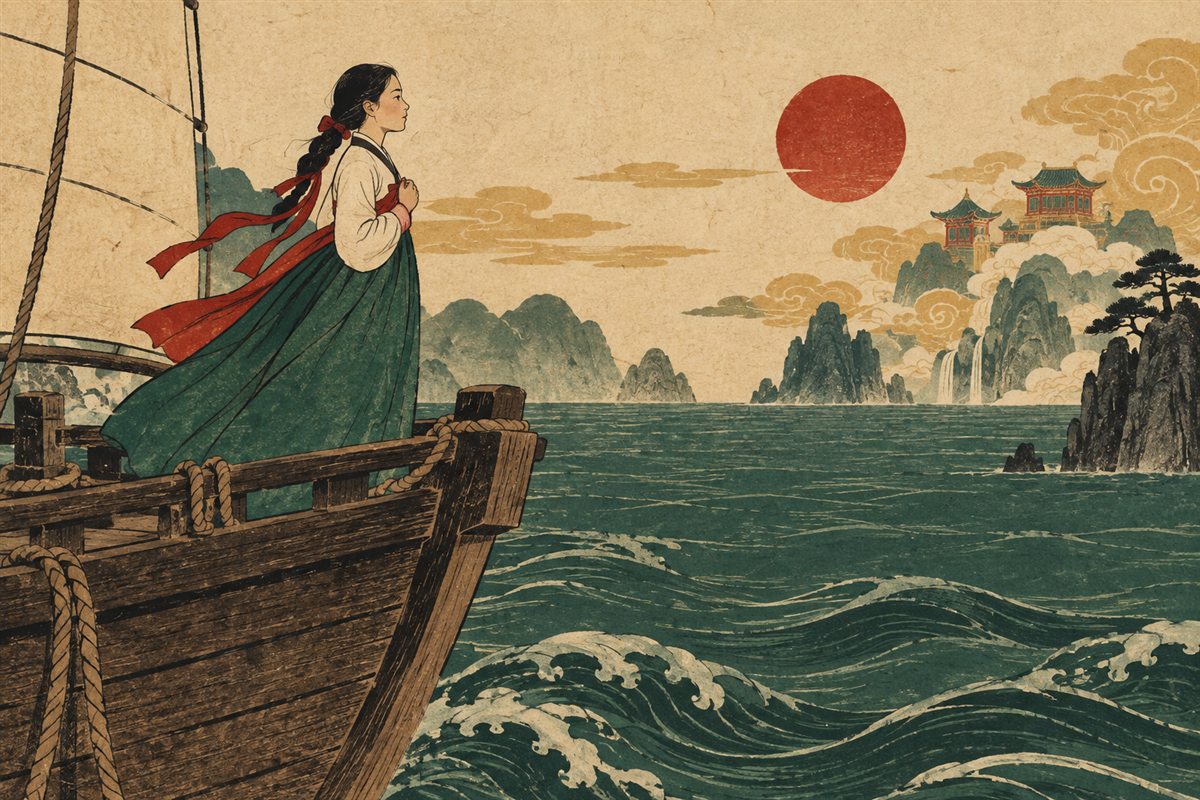
At Indanso, the merchants had prepared the offering and were waiting. Simcheong looked over the wide water. She prayed for the father who would now have no daughter to bring him food. Three times she called to him. Then she covered her face with her hands and leapt into the sea.
She did not sink. A maiden approached in a small boat, lifted her aboard, changed her wet clothes, and gave her a restoring medicine. When Simcheong opened her eyes, attendants were beside her. They had come from the Dragon King to bring her to his palace.
Below the sea, the king welcomed her and arranged for her to return to the human world. She would stay with him for one night. Even there, cared for in a place beyond anything she had known, Simcheong thought of her father and the grief she had left him in.
The next day she was brought back to Indanso inside a great lotus flower. Hidden among its petals, she lived on its dew. When the merchants passed through those waters again, they saw the extraordinary bloom floating where they had made their offering. They lifted it from the sea and presented it to the king of the land.
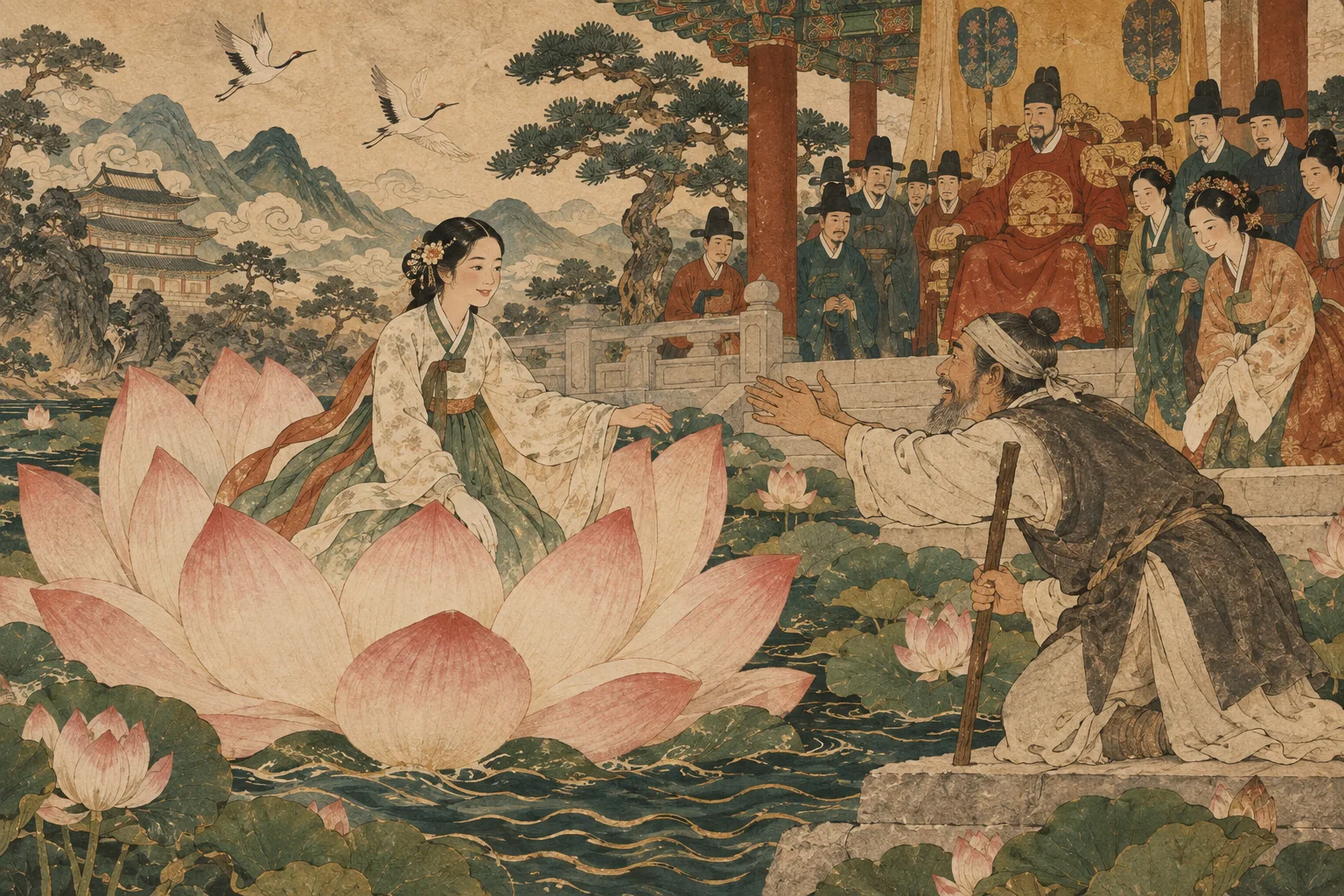
The king kept the flower near his chamber. Simcheong sometimes stepped out when no one was there, then hid again at the approach of others. After the queen died and the court had begun to consider a new marriage, the king caught sight of a woman disappearing into the flower’s enclosure. He opened it and found Simcheong.
She told him she was a human woman, not a ghost or a spirit sent to deceive him. The court welcomed her, and she became queen.
Her father was still missing from her life. Back in the village, he survived with the neighbors’ help, but the food Simcheong had left could not ease his grief. At the palace, she asked for a great feast for blind people from every part of the kingdom. The king ordered local officials to find them and help those too poor to make the journey.
For three days the guests arrived. Simcheong watched for her father and did not find him. On the fourth day, the final group came from distant villages. At the end of the company was a frail man who could barely take his seat. He felt for the food before him and wept instead of eating.
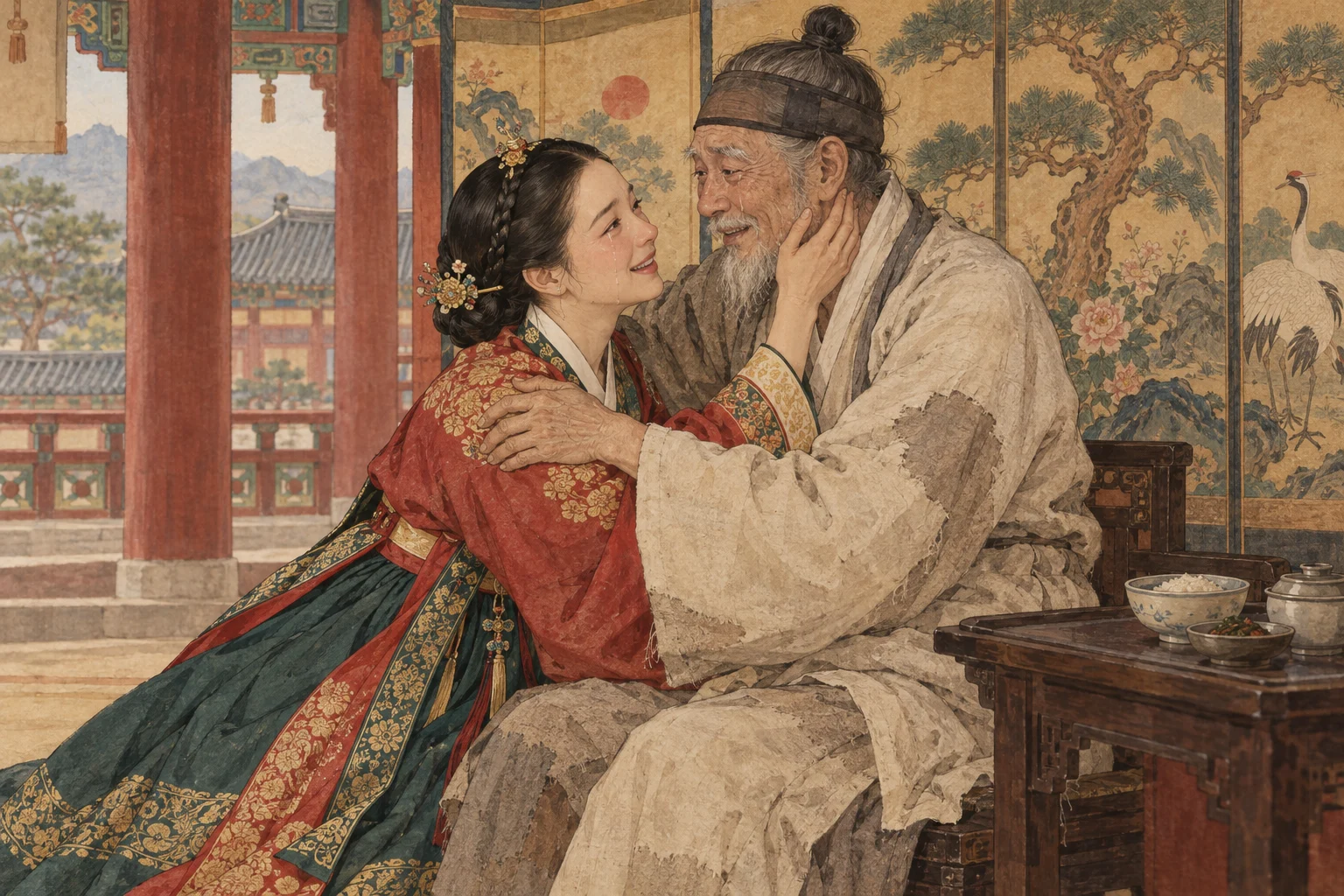
Simcheong recognized him. She had him brought near, called him Father, and collapsed. When she recovered, she went to him and held him. She told him she was the daughter who had been taken to Indanso.
“Are you truly my daughter, Cheong?” he cried. He could hear her, but he still could not see her. In the shock of their reunion he opened his eyes—and his sight returned.
Father and daughter held one another and wept. Sim Hyeon could at last see the child he had thought lost to the sea.
Korean Context in This Story
Simcheong is familiar through the pansori Simcheongga, classical fiction, school readings, and stage and screen adaptations. People often remember three scenes: the rice promised for her father’s sight, her leap at Indangsu or Indanso, and the reunion at the feast. Performances give the farewell and the father’s lament time to unfold, making the cost of the separation as memorable as the miraculous return. Modern readers also discuss the poverty and expectations placed on a daughter whose care sustains the family.
The Korean word hyo, often translated as filial piety, offers one way into Simcheong’s care for her father. Look first at the meals she finds and the neighbors she asks to help: devotion is made visible through daily work. Her father’s plea that she stay also keeps the farewell from becoming a simple lesson in obedience. In pansori, a singer and drummer can hold a listener inside such a parting for longer than a quick reading of the plot allows. The emotional weight comes from spending time with the people who must separate.
A Closer Look
Why is the reunion more than a miracle?
Simcheong has been sustaining her father long before the rice vow. She earns food, arranges his care before leaving, and remains worried about him even in the underwater palace. The extraordinary journey grows out of the ordinary labor of keeping two people alive. Three hundred seok of rice is therefore more than a price: it gives overwhelming scale to a promise made by someone who cannot supply his own supper.
Becoming queen does not solve the separation. To find her father, Simcheong must turn a private wish into a public invitation. The feast depends on local officials finding people and helping those unable to travel. Its fourth-day arrival gives the reunion a slow approach; the ending waits for the guest who can barely reach his seat.
His restored sight follows recognition by voice and embrace. They find one another before he can see her. That order gives the recovery its emotional force: sight completes a reunion already underway.
Read next: Bari-degi brings life-restoring flowers to a father’s funeral. Both daughters make a return possible, but neither pays the same price or comes home in the same way.
How Other Tellings Change the Story
Where is Ppaengdeok's mother in this story?
If you remember Simcheong’s father with Ppaengdeok’s mother, you know a different telling. The Gyeongpan 24-jang edition followed here keeps his life after the farewell comparatively quiet. The broader Wanpan tradition, closely connected with pansori, gives the people around father and daughter much more room.
| What changes? | Gyeongpan 24-jang edition used here | Wanpan tradition described by the Academy of Korean Studies |
|---|---|---|
| Help before the sacrifice | Simcheong finds the merchants' offer and arranges for neighbors to care for her father. | Jang Seungsang's wife offers another possibility and tries to prevent Simcheong's departure. |
| The father's life afterward | Neighbors support him while he grieves for his daughter. | Ppaengdeok's mother enters his life, bringing material concerns and comic complications into the story. |
| The company around them | The narration stays close to the daughter's separation from and reunion with her father. | A wider cast, including other blind people and village figures, creates more social encounters and changes of tone. |
Those differences change how long we spend with the father away from his daughter. They also explain why a remembered performance may feel more crowded, comic, or conversational than this telling. This comparison uses the Academy of Korean Studies’ account of the edition families; individual Wanpan editions and performances can differ further.
Versions and Sources
Read about this telling and other versions
This retelling follows the Gyeongpan 24-jang Simcheongjeon transcription, available in six sections. It keeps the farewell at home separate from the offering at Indanso, and follows the text in having Simcheong float rather than sink after her leap. The lotus, the death of the king’s previous queen, and the four-day feast belong to this edition.
The text also explains Simcheong’s previous heavenly identity as Gyuseong, the Dragon King’s daughter, and foretells her future as queen of the human kingdom. That extended heavenly discussion and the family’s later careers and marriages are abridged here. The Academy of Korean Studies entry on Simcheongjeon distinguishes the Seoul block-print and longer Jeonju traditions, whose episodes differ.
Experience Korean culture
Visiting Korea? Explore an experience connected with what you’ve just read.
Hear Korean music on stage
Discover Korean music and dance through the National Gugak Center's Saturday concert series. It offers a broader introduction to the performing traditions behind Korea's storytelling culture.
Programs vary by date. Check the lineup and available seats before booking.
View concert tickets on Klook (opens in a new tab)Affiliate links: we may earn a commission if you book through these links, at no additional cost to you. Klook handles bookings, availability and prices. About our recommendations.