Pansori: How Korean Stories Become a Performance
판소리
One singer, one drummer, and a roomful of listeners can make a whole story unfold. Learn what to notice in pansori and how it connects with four tales in the Atlas.
A Whole Cast in One Voice
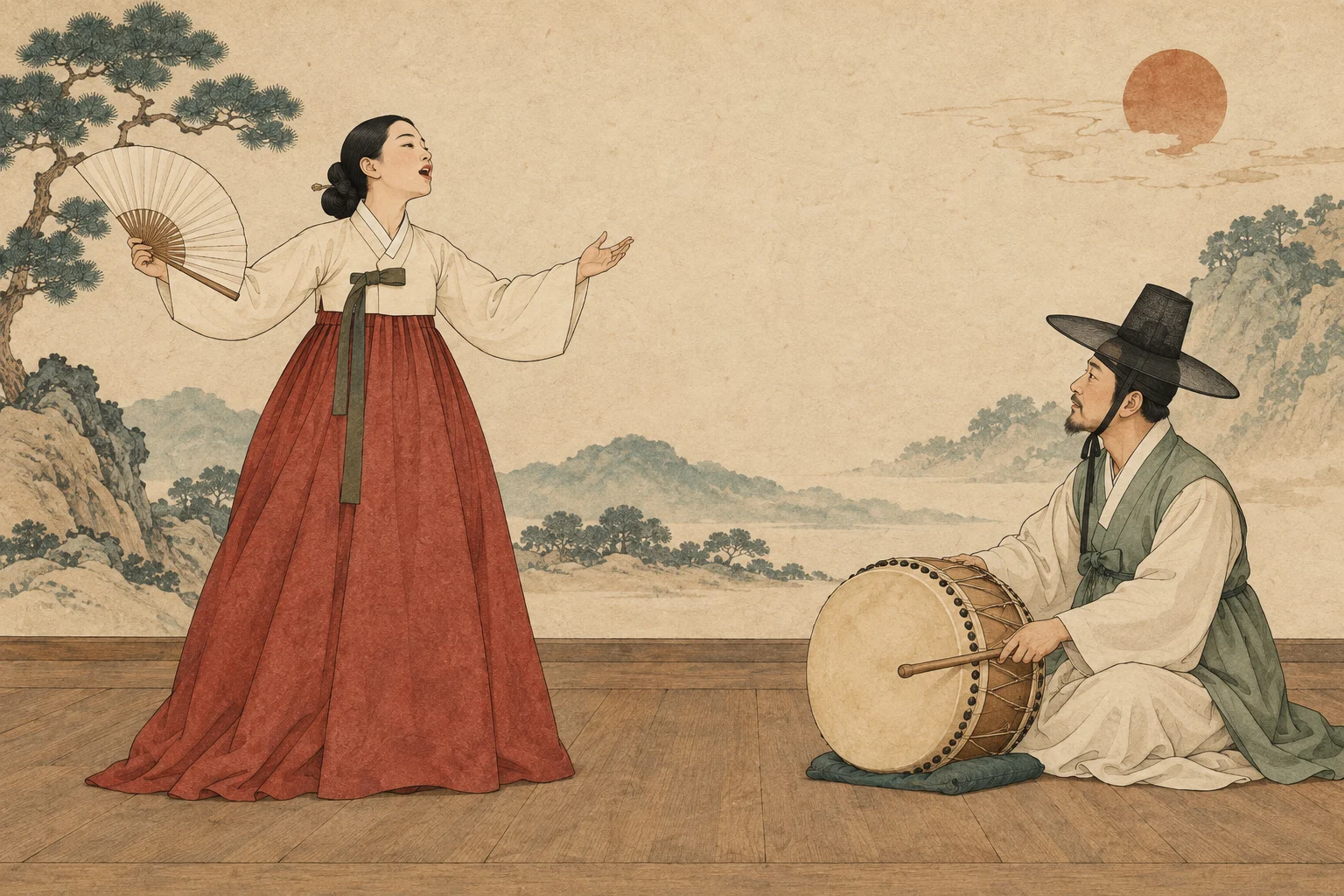
Pansori (판소리) is Korean musical storytelling performed by a singer and a drummer. The singer can carry narration and characters through changes of voice, speech, and gesture. A spectator does not need a separate actor for every person in the plot: the performance asks the audience to help imagine the world.
UNESCO describes an art combining expressive singing, stylized speech, and gesture, accompanied by a barrel drum. Pansori entered its Representative List of the Intangible Cultural Heritage of Humanity in 2008, after an earlier proclamation in 2003. That recognition concerns a living performance tradition, rather than a single script or recording. UNESCO’s introduction includes a video for a first encounter.
Four Things to Notice Before Following Every Word
The singer, or sorikkun. Watch when the storyteller’s body seems to become a character and when it returns to narrating. An open fan can accompany a gesture without needing a complete set of stage props.
The drummer, or gosu. The drum supports the pacing, while vocal encouragement makes the exchange audible. The National Institute of Korean History’s introduction explains how singer, drummer, and listeners together make the performance, and calls the encouraging exclamations chuimsae.
The change between singing and speech. Aniri is the spoken storytelling within pansori. The Academy of Korean Studies explains that it can narrate events or act out dialogue; it has a stylized delivery rather than simply being everyday conversation. A spoken section is therefore part of the performance’s dramatic shape, not necessarily a pause between its “real” songs.
The pace. Jangdan refers to rhythmic patterns. Even without following all the Korean, notice how the pace changes the feeling of an approach, an argument, or a lament. Start by listening for those changes, then return with a synopsis or subtitles.
The terminology above follows the National Institute of Korean History’s English guide and the Academy of Korean Studies entry on aniri.
Four Familiar Story Families
Five major traditional repertoires are transmitted today: Chunhyangga, Simcheongga, Heungboga, Sugungga, and Jeokbyeokga. The Academy of Korean Studies pansori entry describes these repertoires. Four connect with story families you can read here:
- Chunhyang: the lovers’ meeting, separation, imprisonment, and the inspector’s return give the relationship several very different emotional settings.
- Simcheong: a farewell that takes a few paragraphs on a page can become an extended experience of separation in performance.
- Heungbu and Nolbu: the gourd openings invite changes of voice and an expanding procession of surprises.
- The Rabbit’s Liver: the story family associated with Sugungga pits courtly authority against a small animal’s quick answer. The Bito Island telling published here has its own tragic ending; it is not a synopsis of every Sugungga performance.
Why Knowing the Ending Can Make Listening Better
In a plot summary, opening a gourd is an event on the way to a result. In performance, waiting for it to open can be part of the pleasure. A listener who knows the broad story has room to notice how a voice builds expectation, how a familiar exchange is delivered, or how a character changes the atmosphere.
Try this with Heungbu. First read the swallow and gourd sequence. Then listen to a performance excerpt and ask how much time is spent on anticipation compared with the eventual discovery. You are looking for what performance does with time, rather than checking whether every line matches the prose on this site.
Choosing a First Excerpt
Pick a story you already know and look for a recording that identifies the performer and passage, with a synopsis or subtitles you can follow. A short excerpt can give a clearer first impression than starting an unfamiliar full-length performance. Follow the singer’s changes of voice and the drummer’s responses before trying to learn technical names for every musical feature.
For an institutional starting point, use the UNESCO video or the National Institute of Korean History introduction linked above. You can then come back to the printed story and see which moments feel larger after you have heard them performed.