The Rabbit’s Liver
토끼의 간 · 별주부전
A terrapin promises a rabbit wealth and a place at the Dragon King's court. Under the sea, the rabbit discovers why the king really wanted him to come.
Story at a Glance
A rabbit leaves his pregnant mate on the shore to follow a stranger’s promises. When the invitation becomes a threat to his life, his only way home is to persuade the stranger to carry him back.
The Story
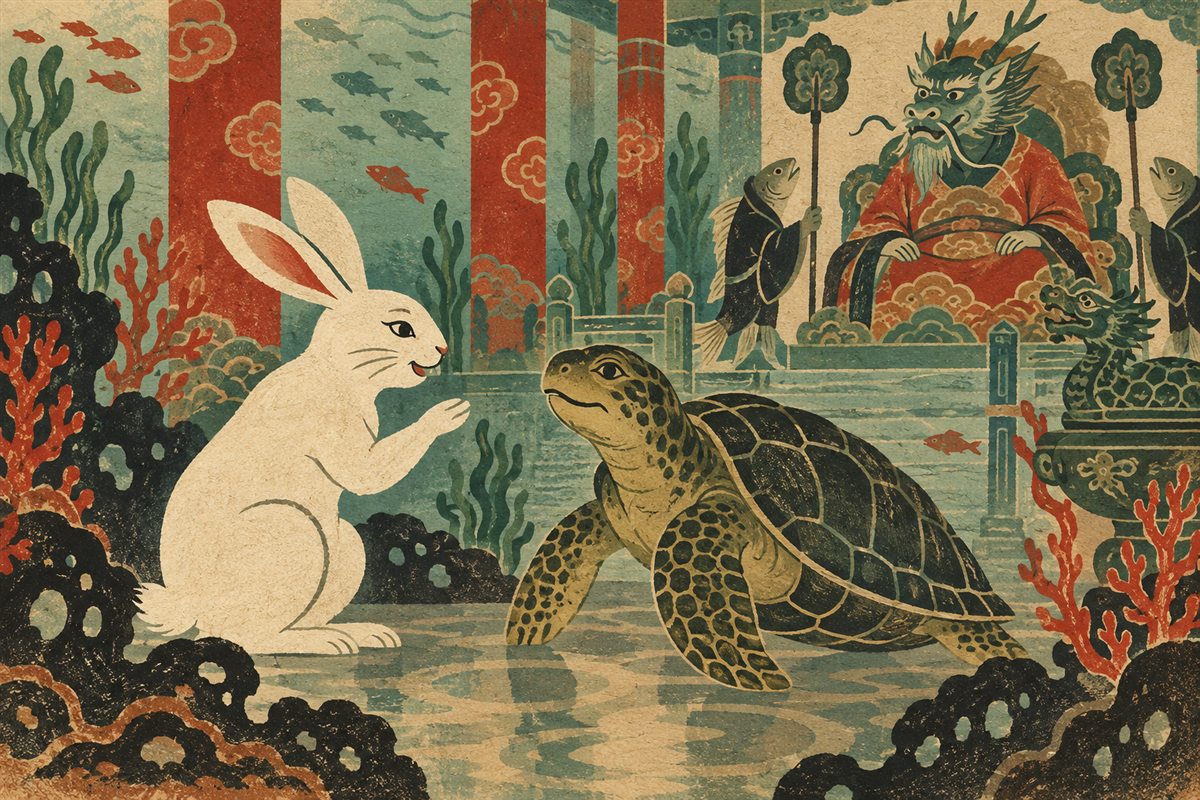
A rabbit and his pregnant mate were together by the shore of Wolteungdo when a terrapin came up from the sea. The visitor brought an invitation from the Dragon King’s palace. There, he said, the rabbit could become a high official and enjoy great wealth. He could even have a more beautiful wife.
The rabbit accepted. His mate remained on the island while he climbed onto the terrapin’s back. The terrapin carried him away from the shore and down to the court beneath the sea.
The palace was nothing like the welcome the rabbit had expected. It was subdued, and the Dragon King lay gravely ill. The rabbit asked the terrapin what was wrong.
Only then did the terrapin admit the purpose of the journey. The king needed a rabbit’s liver to cure him. The terrapin had promised to bring one back. The honors he had described on the beach had been a way to obtain the animal the king required.
The rabbit was brought before the Dragon King. The sick ruler explained that he needed the liver as medicine. The rabbit had no route back to the surface except on the back of the creature who had deceived him.
He answered as though there had been a simple mistake. Creatures of the sea, he said, did not understand how animals lived on land. Rabbits did not always carry their livers inside their bodies. For fifteen days of the month, they took them out and hung them on cinnamon trees. Sunlight and sea air made a liver kept that way especially good medicine.
His own liver was hanging on a tree at home. He had left it there before setting out. If the king wanted it, the terrapin would have to return him to the island to fetch it.
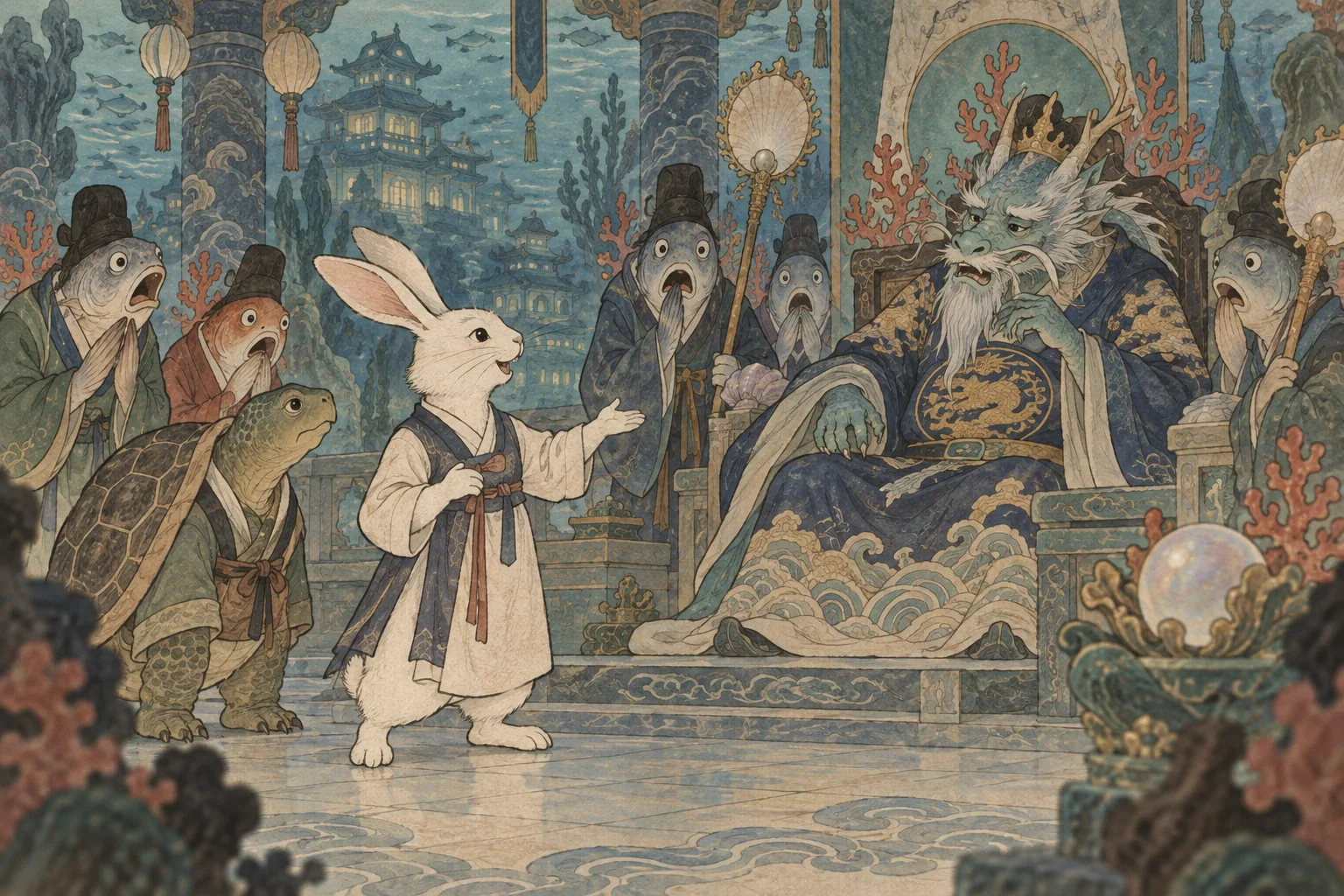
The Dragon King believed him. The terrapin was ordered to take the rabbit back and bring the medicine without delay. Once again the rabbit climbed onto his back. They left the palace and rose into the sea above it.
This time the rabbit watched for land. It was a full-moon night, and the island shone ahead of them. The moonlight and its reflection made the shore seem closer than it was. The rabbit thought he could reach it without waiting for the terrapin to arrive.
He leapt.
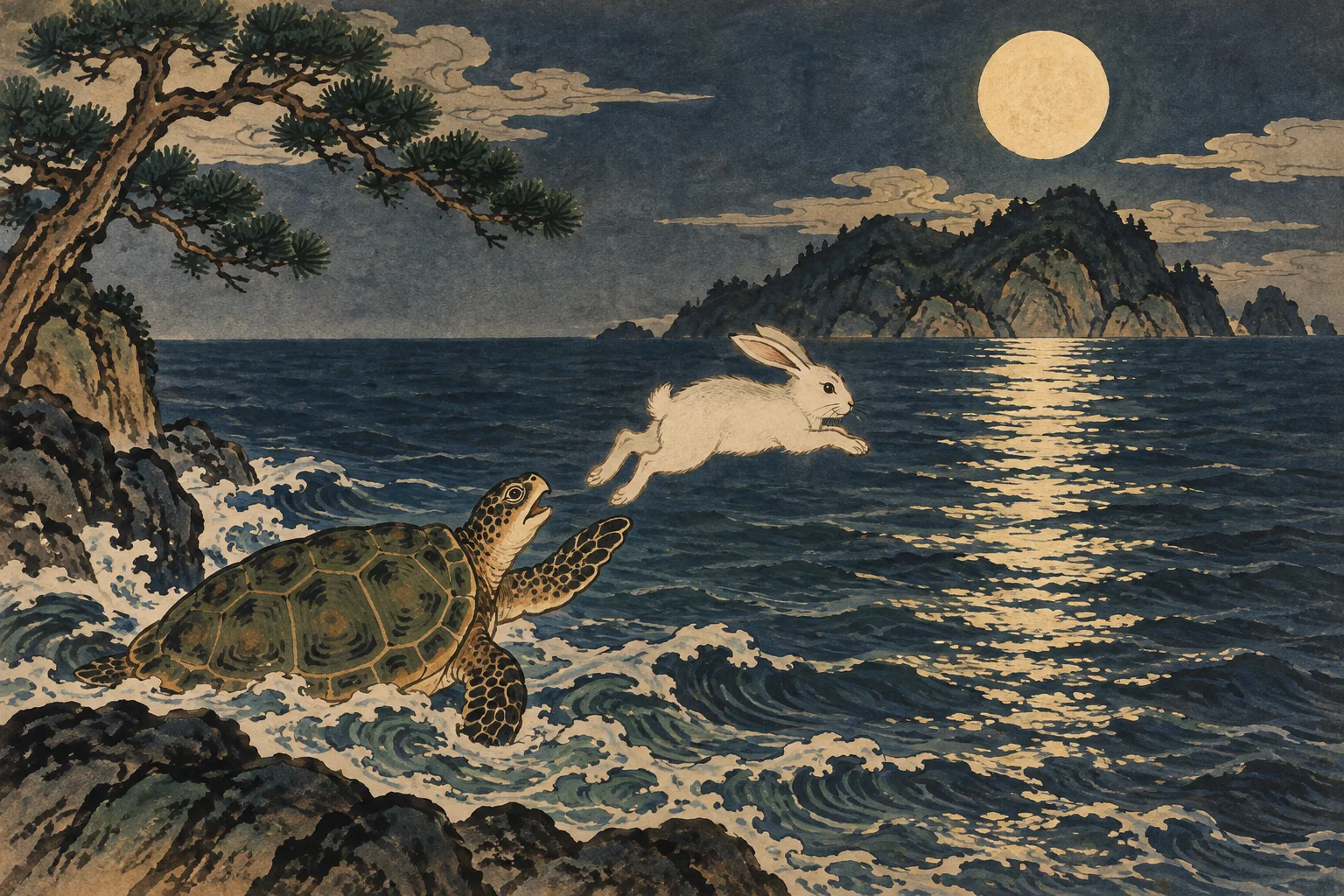
His feet found water instead of ground. He had jumped too soon. He fell beneath the surface and drowned. The place where he died came to be called Rabbit Island.
The terrapin could not bring the liver back. He feared what the king would do when he returned without either the medicine or the rabbit, and he took his own life. That place became Turtle Island.
On shore, the rabbit’s mate learned what had happened. She stretched her neck in grief and died as well. Her death was linked to Mokseom, Neck Island. The rabbit’s journey had ended within sight of the home he had left, and the names along the coast kept the three losses together.
Korean Context in This Story
The rabbit’s claim that he left his liver on land is widely known through Sugungga, a pansori story, and the literary Tokkijeon. It is a classic moment of quick thinking against someone with greater power. Many listeners expect the rabbit to reach shore and escape. Around Bito Island, the familiar trick also belongs to a local landscape story: the ending connects the animal characters to neighboring islands. Knowing the usual comic escape makes this coastal ending particularly poignant. Meet the Dragon King →
For another way to encounter this story family, explore pansori, the singer-and-drummer tradition that includes Sugungga. The underwater court and the rabbit’s answer offer room for shifting voices, persuasion, and comic timing. Coming back to the Bito telling afterward changes the experience: the clever answer gets the rabbit out of the court, but does not carry him through every danger on land. The coastal ending asks the listener to stay with the characters after the familiar trick has worked.
A Closer Look
Follow the setting: Bito Island and the names along the coast make this telling’s final journey especially distinctive.
The rabbit wins the argument, then loses the journey
The terrapin’s invitation and the rabbit’s answer are parallel inventions. One promises an official career and wealth to bring the rabbit into danger. The other invents a removable liver to get him out. Both work because the listener wants the promised thing badly enough to accept an implausible explanation.
The rabbit regains a way to shore through language, but still depends on the terrapin to carry him there. The last leap confuses being near home with having arrived. Moonlight makes the error possible; the lie that saved him in the palace cannot help him in the water.
The ending then widens beyond the clever protagonist. The terrapin fears returning without the cure, and the mate left ashore grieves the rabbit’s death. Three linked places carry three losses. If you know a version where the rabbit escapes and mocks his captor, this coastal telling changes the question from “Who is cleverest?” to “Who bears the cost of the king’s demand?”
Read next: The Jangja Pond Legend also makes a failed escape part of a place’s remembered shape. Its warning, hill, pool, and stone organize the landscape differently.
How Other Tellings Change the Story
Why doesn't this rabbit simply escape?
Jo Maeng-ji’s Bito Island recording follows the rabbit beyond its successful trick. The Academy of Korean Studies survey of Tokkijeon describes a different outcome on shore.
| Moment | The Bito telling on this page | The surveyed escape plot |
|---|---|---|
| The answer in the palace | The rabbit claims its liver is on land. | The rabbit uses the same claim to secure a return journey. |
| Back on shore | A leap toward land goes wrong, and the rabbit dies. | The rabbit reaches safety and mocks the terrapin. |
| What remains | The deaths become part of the island landscape’s explanation. | The escape completes the reversal of the underwater court’s power. |
The ruse works in both plots: the ruler agrees to let the rabbit leave. What changes is whether that victory lasts. In the local telling, the final journey gives familiar wit a sudden tragic turn. Read the last scene as part of this island account, rather than replacing it with the escape you may expect from Sugungga.
Versions and Sources
Read about this telling and other versions
This page follows Jo Maeng-ji’s “Bito Island Legend,” recorded in Sacheon in 2013. The rabbit leaves a pregnant mate, invents the cinnamon-tree explanation, and jumps too early toward the moonlit island. He does not mistake the moon itself for land. The three deaths and place names are part of the local legend, not established historical etymologies.
The Academy of Korean Studies overview of Tokkijeon describes literary and pansori versions with different outcomes. The familiar surviving-rabbit ending is not appended to this telling.