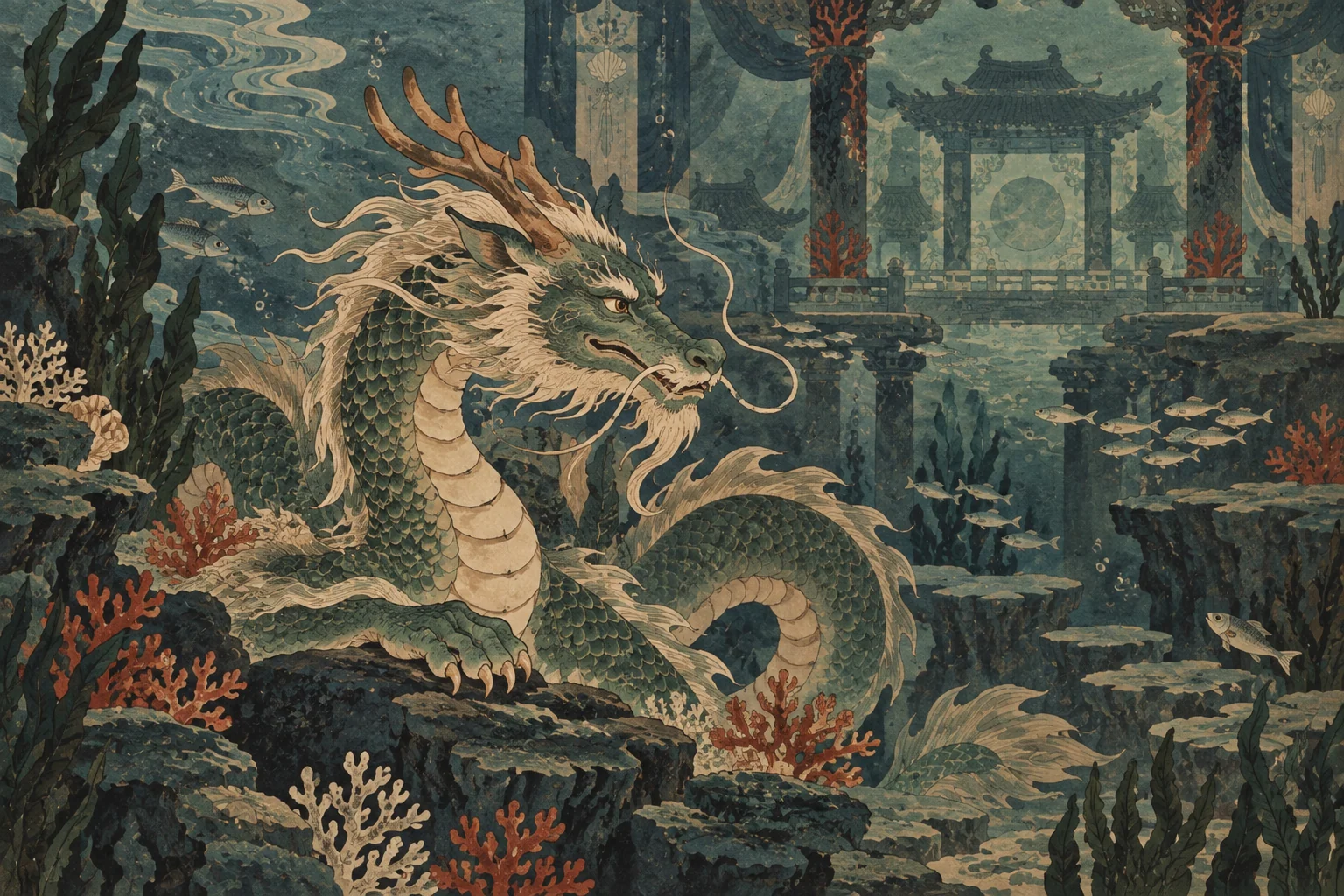
Yongwang
용왕
The Dragon King associated with water in Korean traditions, appearing in stories and practices whose details vary.
Quick Summary
Yongwang (용왕), often translated as Dragon King, is a water-associated deity or ruler in Korean narrative and ritual traditions. The stories do not all give the figure one fixed character or appearance.
Water, Rain, and Otherworlds
The Academy of Korean Studies’ entry on dragons describes water- and rain-related beliefs and names several forms of a dragon deity, including yongwang and yongwang halmeoni. The names and practices vary by region and community. A translation such as “Dragon King” is useful, but it can hide the different titles and local forms recorded in Korean sources.
Stories also place a dragon court or palace beneath the water. In a literary tale, that court lets the plot move between land and an underwater realm; it is not a literal map of ritual belief. Keeping the narrative setting separate from local worship helps avoid treating every water deity as the same monarch.
In The Rabbit’s Liver
The Yongwang in this retelling is the ruler whose illness sets the plot in motion. The rabbit, turtle, and liver episode belong to the selected narrative. Other dragon-king stories may have different concerns and outcomes.
Three Different Encounters with the Water World
The court in The Rabbit’s Liver makes a ruler’s illness dangerous to someone far outside his kingdom. The rabbit is invited with promises of wealth, then discovers that he is wanted as medicine. The palace has power, messengers, and ceremony, but its ruler can still be deceived by the animal he intends to consume.
In Simcheong, the underwater palace has a different place in the journey. The Dragon King’s attendants receive Simcheong after her leap at sea, and the king arranges her return inside a lotus. A descent that seemed to be an ending becomes a passage back to the human world. This does not make the two rulers one shared character; it shows how differently an underwater court can serve a story.
Manpasikjeok brings a dragon to meet a human king at a floating mountain. That dragon delivers a gift on behalf of Munmu and Kim Yusin. The text does not identify the messenger as Munmu himself. Read this as a related dragon narrative, rather than another episode of the sick king from the rabbit’s tale.
Sources
- Academy of Korean Studies, Encyclopedia of Korean Culture: Dragon (dragon and dragon-deity traditions).
- Academy of Korean Studies, Encyclopedia of Korean Culture: Dragon Palace Tales (the literary underwater-court motif).