The Bamboo That Became the Manpasikjeok
만파식적
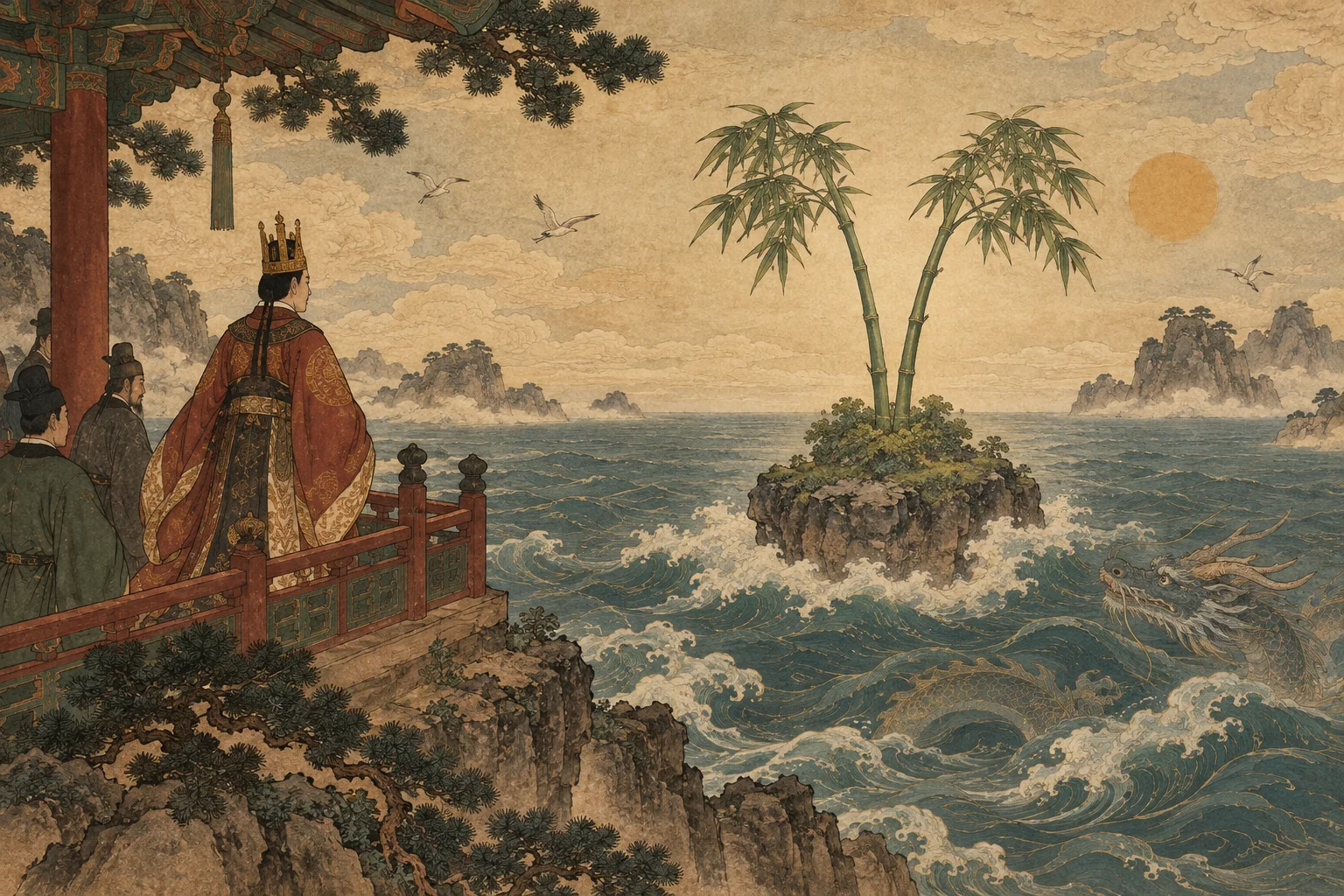
A small mountain floats toward Silla's coast, carrying a bamboo stalk that divides and joins again. King Sinmun goes out to discover what the sea has brought him.
Story at a Glance
A mountain appears on the water, and the royal diviner calls it a gift from the kingdom’s protectors. Before Sinmun can reach it, the sea turns dark with a storm.
The Story
King Munmu of Silla died before the temple he was building on the eastern coast was finished. He wished to protect his country even after death and became a dragon in the sea. His son, King Sinmun, completed the temple and named it Gameunsa.
One day a coastal official brought Sinmun strange news. A small mountain was floating in the East Sea. It moved with the waves and seemed to be approaching the temple.
The king asked his diviner to interpret the sign. The answer linked it to his father, the sea dragon, and to the great general Kim Yusin, now a heavenly protector. They were sending a treasure to guard the country. Sinmun should go to the coast to receive it.
He went to the lookout at Igeondae and sent a messenger to inspect the mountain. It was shaped like a turtle’s head. A single bamboo stalk grew on it. By day it divided into two; at night the two parts joined again. The messenger brought this report to the king, who stayed at Gameunsa.
The next day the bamboo came together, and the earth and sky shook. Wind and rain swept over the water. For seven days the sky was dark. Only when the weather cleared and the waves settled could Sinmun take a boat out to the mountain.
A dragon met him there and presented a black jade belt. Sinmun asked about the mountain and its bamboo: why did they separate and come together?
The dragon explained with the sound of hands. A single hand could not clap on its own; two brought together could make a sound. So too with the bamboo. Joined, it would produce a sound through which the king could bring peace to the land. He should cut it and make a flute.
The gift came from Munmu and Kim Yusin, the dragon said. They had sent it with a shared purpose, to protect the country.
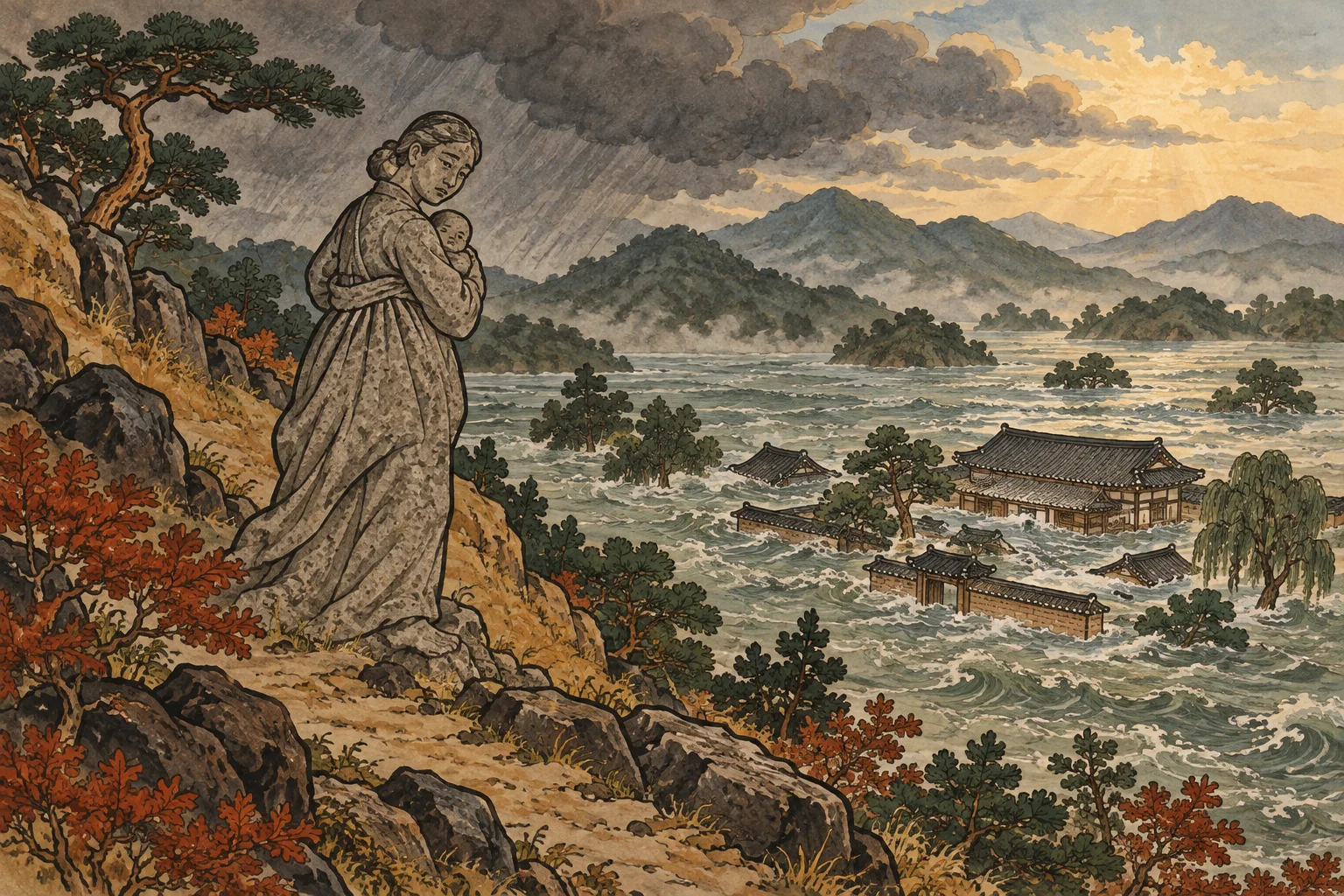
Sinmun gave silk, gold and jade in return. He had the bamboo cut and carried it away. As he left the sea, both the mountain and the dragon vanished.
On the journey back, the crown prince came to meet him. He examined the jade belt and said its pieces were living dragons. To test it, one piece was put into a stream. It became a dragon and rose into the sky. The place became a pond called Yongyeon, Dragon Pool.
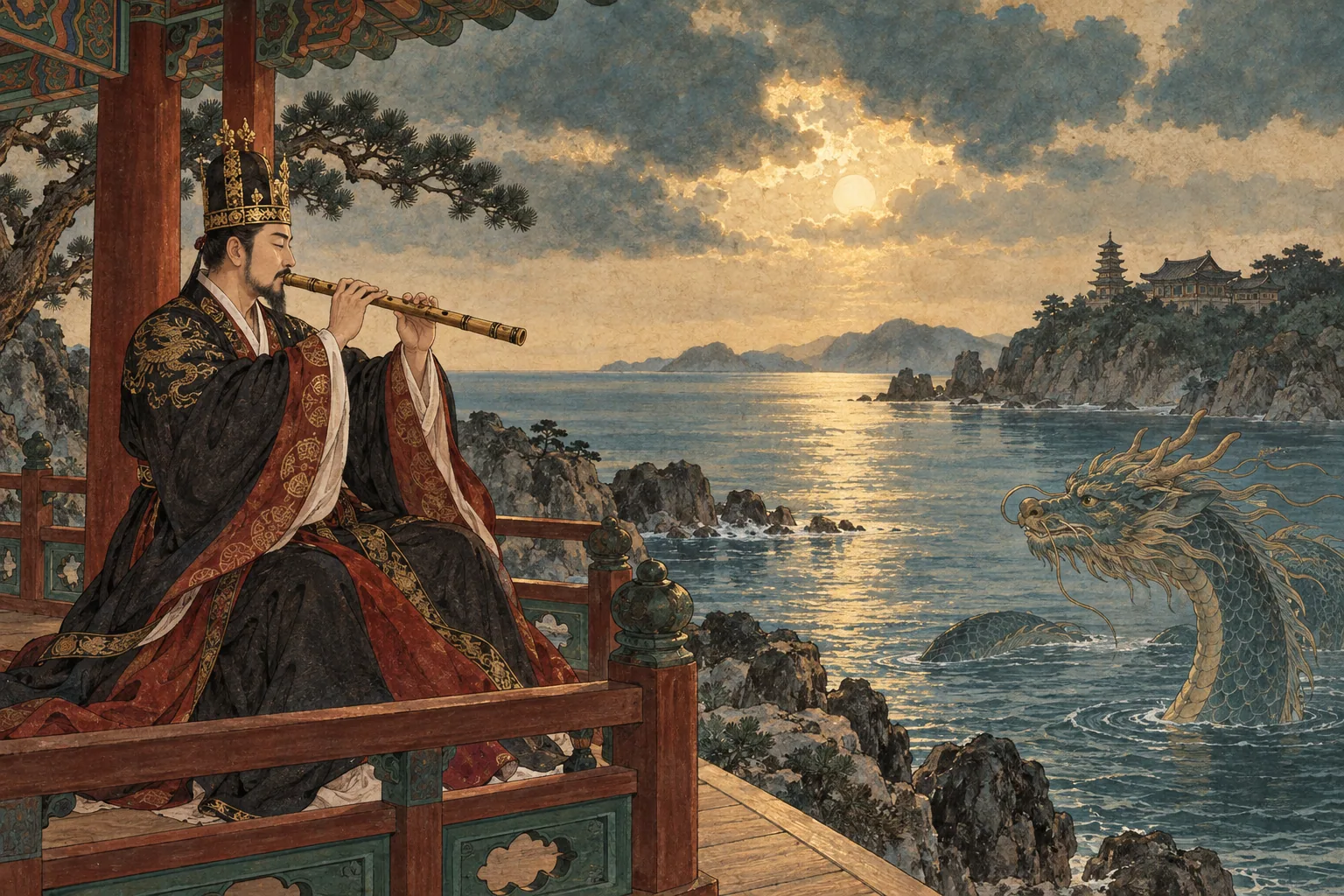
Back at the capital, the bamboo was made into a flute and kept in the royal treasury. When it sounded, enemy troops withdrew and sickness was healed. In drought it brought rain; in long rain it brought clear weather. Wind quieted, and waves grew calm.
The king called it Manpasikjeok, the flute that quiets ten thousand waves. The small mountain had disappeared, but the gift it carried remained with the kingdom.
Korean Context in This Story
The Manpasikjeok is remembered as a royal flute whose music could bring peace. Its name evokes waves settling, and the legend joins music, protection of the country, and a king’s bond with his father. Gameunsa and the eastern coast around Gyeongju give the story a recognizable landscape. The instrument itself belongs to the legend; the temple remains and coastal sites are places where people encounter and retell it. Explore the flute’s cultural story →
A Closer Look
Follow the setting: Gameunsa on Gyeongju’s eastern coast places the temple ruins beside the dragon legend without confusing the remains with the marvelous event.
Why does a ruler receive a flute?
The strange bamboo first appears as a problem of division and reunion. The dragon’s clapping comparison makes that spectacle understandable through the body: two hands create a sound that one cannot. The flute then turns the joined bamboo into an instrument the king can actually use. Sound connects the marvel seen at sea to the peace promised on land.
The list of powers is broader than victory over enemies. The instrument also heals sickness, answers drought, ends excessive rain, and quiets wind and waves. Protection includes the conditions people need to live, not only the defense of a court. That range gives the name “the flute that quiets ten thousand waves” a meaning larger than a calm sea.
The jade belt offers a second, smaller demonstration of the same crossing between object and living power. A piece becomes a dragon in a stream, leaving Dragon Pool as a remembered place. The mountain disappears, while the flute and the new place name carry its consequences forward.
Read next: Dangun also connects rule with weather, food, and forces beyond the human world. Compare its founding community with Sinmun’s inherited responsibility to protect an existing kingdom.
Versions and Sources
Read about this telling and other versions
This retelling follows Samguk Yusa, volume 2, “Manpasikjeok,” in the National Institute of Korean History database: Gameunsa, the floating mountain, the dragon and jade belt, and the flute and Dragon Pool. The text describes seven days of darkness during the storm. The dragon who delivers the gift acts for Munmu and Kim Yusin; it is not identified as Munmu himself.
The later renaming of the flute is omitted. Samguk Sagi, volume 32, preserves a shorter mountain-and-bamboo account, names the flute Manpasik, and expresses doubt about the tale. That shorter account is a comparison, not a second ending to this story.
Experience Korean culture
Visiting Korea? Explore an experience connected with what you’ve just read.
Explore Silla's capital in Gyeongju
Discover the royal heritage of Silla with an English-speaking guide. The tour offers a closer look at Gyeongju's historic sites and museum collections.
Check the itinerary and meeting point for your chosen package.
View the tour on Klook (opens in a new tab)Affiliate links: we may earn a commission if you book through these links, at no additional cost to you. Klook handles bookings, availability and prices. About our recommendations.