The Dangun Foundation Myth
단군 신화
In the account preserved in Samguk Yusa, Hwanung descends to earth, a bear endures a test, and their story leads to Dangun and the founding of Joseon.
Story at a Glance
Hwanung, son of the heavenly ruler Hwanin, comes down to the human world. A bear and a tiger ask to become human. Their trial separates them: the tiger leaves, while the bear endures and becomes Ungnyeo. From her union with Hwanung comes Dangun, remembered in the account as the founder of Joseon.
The Folktale — Faithfully Retold
Hwanin, ruler of the heavens, had a son named Hwanung. Hwanung looked toward the human world and wished to descend there. His father saw that the world below could be governed and entrusted to him the signs of authority: three heavenly seals.
Hwanung came down with three thousand followers to Taebaeksan, the great white mountain. Beneath a sacred sandalwood tree he established a divine city. He and his ministers oversaw matters that touched human life: grain, life and death, sickness, punishment, good and evil, and the many concerns through which people shaped their days.
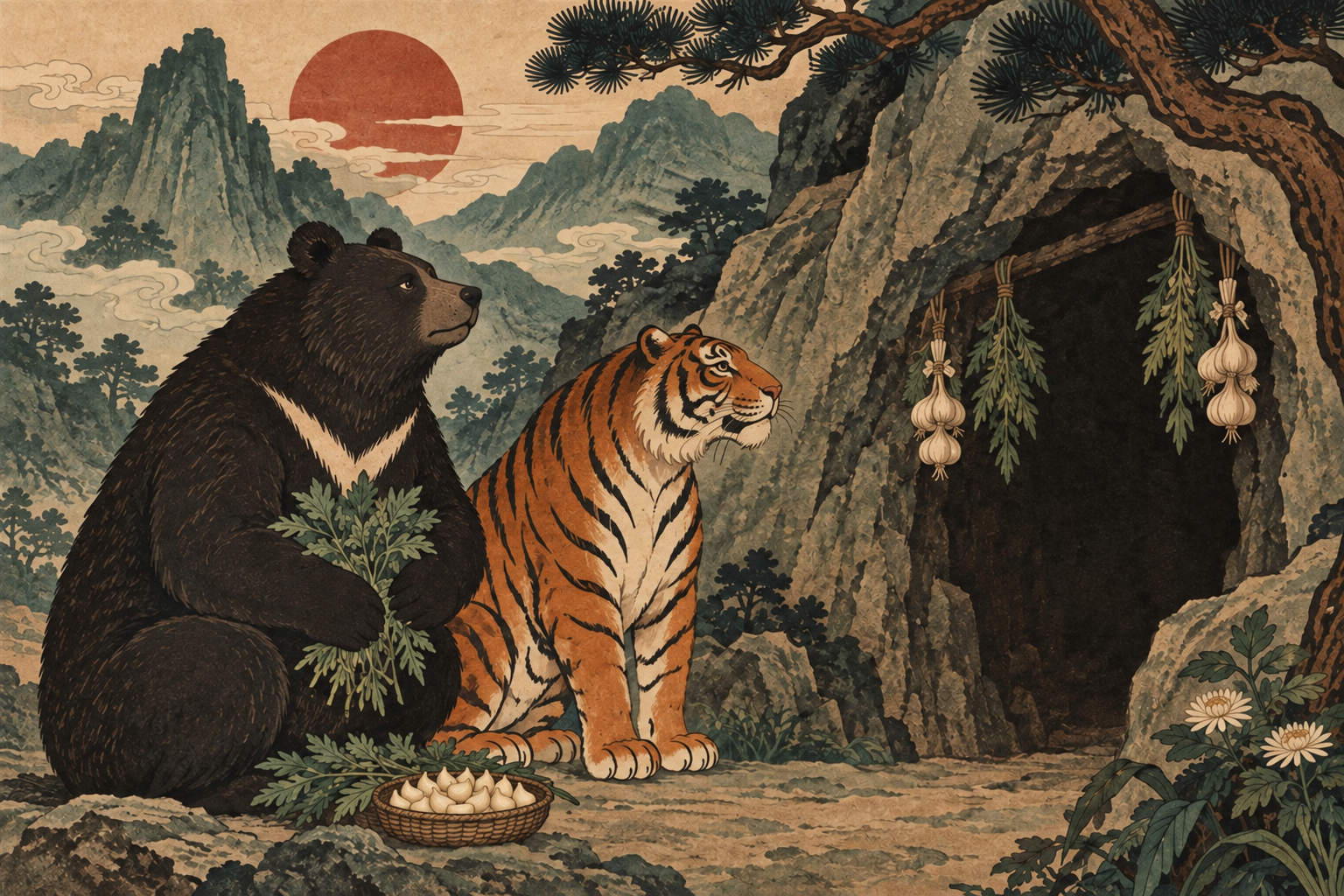
A bear and a tiger came to the city. They prayed to become human. Hwanung gave them These are the foods named in the selected Samguk Yusa passage. The tale does not establish a broader ritual meaning for them. Read the source note → and instructed them to avoid sunlight for one hundred days. The chronicle then says they observed the taboo for three sets of seven days: twenty-one days. The bear became a woman; the tiger did not. The text thus preserves a discrepancy between the instruction and the narrated duration.
The pair went into a cave. They ate the mugwort and garlic and waited in the darkness. The tiger could not bear the confinement and left. The bear stayed. After the three-week observance, she was transformed into a woman called Ungnyeo.
Ungnyeo had no human partner with whom to have a child, and she prayed beneath the sandalwood tree. Hwanung heard her prayer. He temporarily took human form, and Ungnyeo conceived. She gave birth to a son, Dangun Wanggeom.
Dangun became ruler and established the kingdom called Joseon in the account. The chronicle gives a legendary date and tells that he later withdrew to a mountain and became a mountain spirit. The story thus traces a line from heaven, through the endurance and transformation of Ungnyeo, to the founding of a human kingdom.
Korean Context in This Story
This page follows the Dangun narrative in Samguk Yusa, a medieval compilation that preserves earlier material. A separate account in Jewang Ungi changes the mother’s origin: it tells of Hwanung’s granddaughter transformed into a woman, rather than the bear-woman Ungnyeo. The two should not be merged into one version. The myth is a foundation narrative, not independent evidence for the dates it gives.
Versions and Sources
Selected primary text: Samguk Yusa, Gi-i 1, “Gojoseon / Wanggeom Joseon”, with Chinese text and Korean translation. The passage instructs a hundred-day taboo but narrates only three seven-day periods; it also questions the date assigned to Dangun’s founding. Comparison: Academy of Korean Studies, “Dangun Myth” describes the different maternal origin in Jewang Ungi. This English retelling follows Samguk Yusa and treats its chronology as the text’s claim, not verified history.
Retold in original English prose.
Source and plot checked 2026-10-04. See the source note for whether the basis is a primary text, oral record, or scholarly summary.