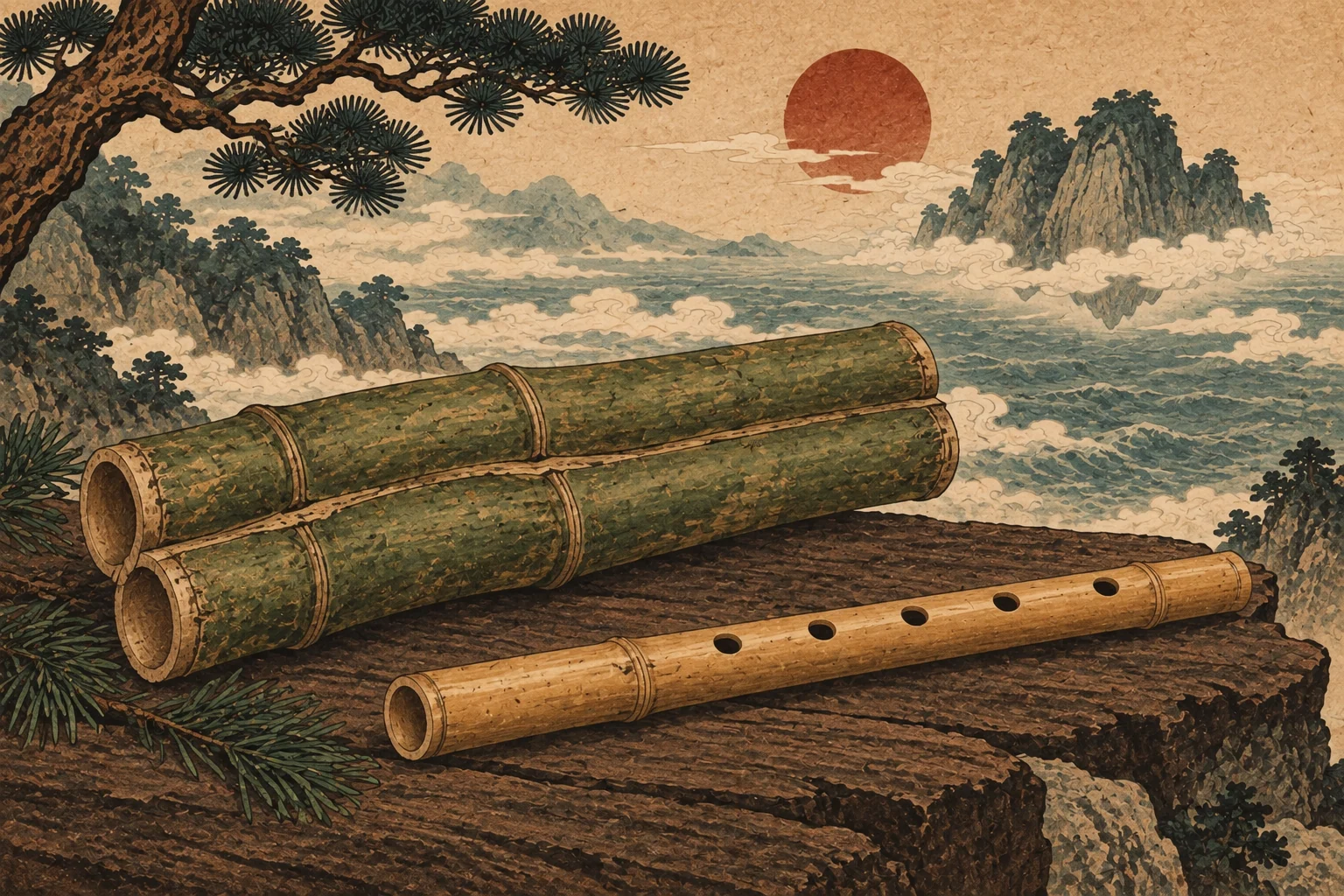
The Manpasikjeok as a Story Object
만파식적
A legendary flute in written accounts of King Sinmun, said to quiet troubles; no surviving instrument is identified as the Manpasikjeok.
What the Name Means
Manpasikjeok (만파식적, 萬波息笛) is usually glossed as a flute that quiets the troubles or “many waves” of the world. In the Samguk Yusa narrative, its bamboo comes from a remarkable plant on a floating sea mountain. The flute’s sound is said to settle danger and disorder.
A Written Legend, Not a Surviving Instrument
The Samguk Yusa and Samguk Sagi preserve related accounts, but neither identifies a surviving instrument that can be verified as the Manpasikjeok. The Samguk Yusa gives the longer story and names the flute Manpasikjeok. The Samguk Sagi cites an old record, calls the instrument Manpasik, and ends by saying that the story is too strange to believe.
The flute’s peace-bringing power is part of the narrative. The historical interpretation offered in the National Institute of Korean History’s reading guide connects the legend with hopes for political stability and royal legitimacy in early Unified Silla. That scholarly interpretation is distinct from what the story itself says.
From Divided Bamboo to a Shared Sound
The flute’s material has its own story before it becomes an instrument. The bamboo divides and joins, and the dragon compares its joining to two hands clapping. The explanation brings the strange sight down to an action a listener can try. The source then gives the king the joined bamboo to turn into music.
The powers attributed to that music include opposite remedies: rain during drought and clear skies during prolonged rain. The desired result is a return to balance, rather than more of any one condition. Enemy withdrawal and healing sit beside these changes in weather. Together they make the instrument a compact image of protection for a whole country.
Finding the Legend in the Landscape
The story gives readers several places to follow: Gameunsa, the coastal lookout at Igeondae, the floating mountain, and Yongyeon, the Dragon Pool formed during the return. The temple and lookout anchor the king’s journey before the narrative moves into its marvels. The pool gives the jade belt’s transformation a place name afterward.
When reading or encountering the legend around Gyeongju, distinguish those named landmarks from the flute itself. A place can preserve an association with a tale without preserving every object the tale describes. Follow Sinmun’s journey →
Sources
- National Institute of Korean History, Samguk Yusa, volume 2, “Manpasikjeok”.
- National Institute of Korean History, Samguk Sagi, volume 32, “An Old Record on the Manpasikjeok Legend”.
- Academy of Korean Studies, Encyclopedia of Korean Culture: Manpasikjeok Legend.
Explore these stories
Continue through Objects Found in Korean Folktales →
Experience Korean culture
Visiting Korea? Explore an experience connected with what you’ve just read.
Explore Silla's capital in Gyeongju
Discover the royal heritage of Silla with an English-speaking guide. The tour offers a closer look at Gyeongju's historic sites and museum collections.
Check the itinerary and meeting point for your chosen package.
View the tour on Klook (opens in a new tab)Affiliate links: we may earn a commission if you book through these links, at no additional cost to you. Klook handles bookings, availability and prices. About our recommendations.