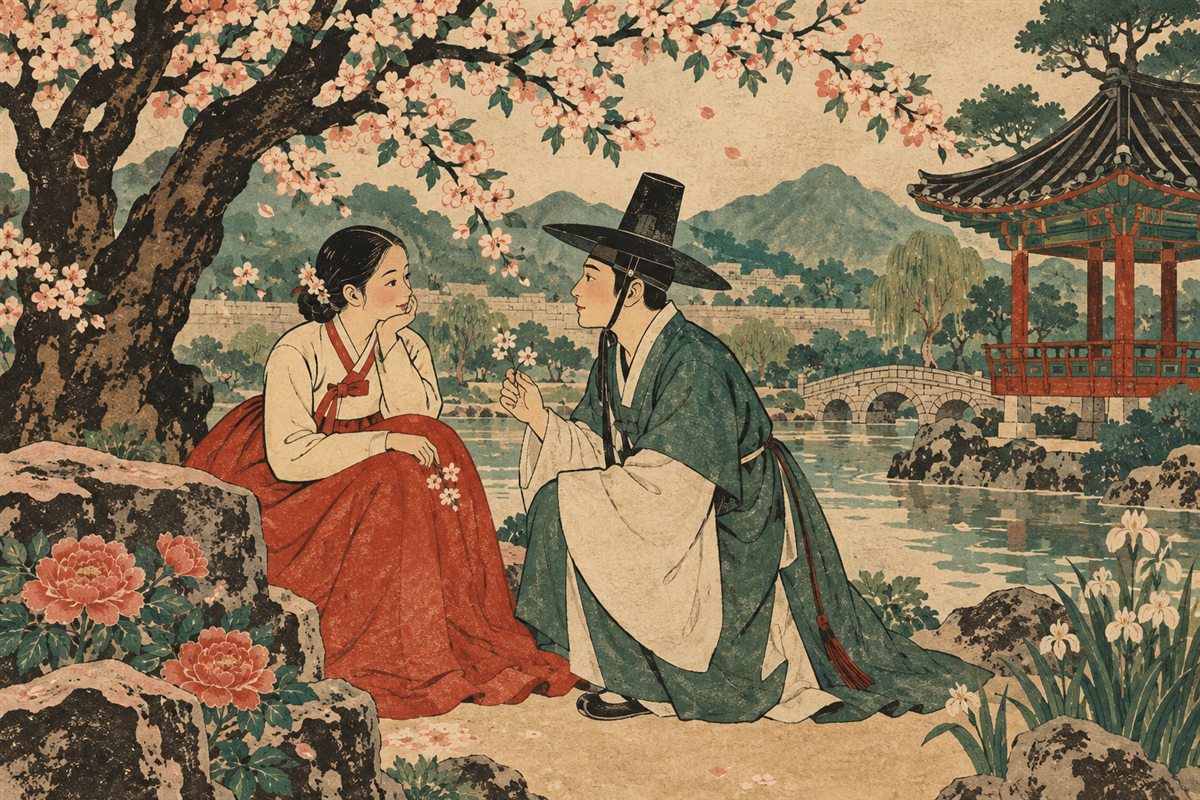
The Tale of Chunhyang
춘향전
In an early Chunhyang narrative, a young couple’s promise is tested by separation, an abusive magistrate, and a return that turns private fidelity into public justice.
Story at a Glance
Chunhyang, the daughter of Wolmae, meets Yi Mongryong, the son of Namwon’s magistrate. They choose one another and make a promise before his family leaves for the capital. When the new magistrate tries to claim Chunhyang, she refuses. Mongryong later returns in disguise, reveals the abuse of office, and takes Chunhyang away from the life imposed on her.
The Folktale — Faithfully Retold
Spring brought people out to enjoy the day in Namwon. Chunhyang, fifteen, went to play by the stream in front of Manbuksa. She bathed and rode a swing. Yi Mongryong, sixteen, saw her there. Through his attendant Bangja, he found a way to meet her. Chunhyang is a young donggi, a child gisaeng, in this early poem; the scholarly summary describes her choice to enter the relationship and the material token she receives. Mongryong wrote her a token promising that he would not forget her, then returned to the magistrate’s residence and told his sister about the relationship.
For a time they were together. Then Mongryong’s father’s term as magistrate ended, and the family had to return to Seoul. Chunhyang sang a farewell song as they parted. Their separation left her in Namwon with the written token and a promise, but no protection from the official power that would soon bear down on her.
A new magistrate took office. He summoned Chunhyang and demanded that she serve him. She would not abandon the commitment she had made to Mongryong. The magistrate answered refusal with punishment. In the early narrative preserved by Yujinhan, the account of this suffering reaches Mongryong while she is in prison; he hears what has happened from Chunhyang herself.
Mongryong won first place in the royal examination and rose through government posts before receiving an appointment as regional inspector. On his way south, he asked a farmer about the local magistrate. The farmer warned that the official was reckless. Mongryong went to Chunhyang’s home, but her mother Wolmae mistook the inspector’s disguise for poverty and looked down on him. He then found Chunhyang in prison. She told him how she had refused the magistrate and had been jailed. She feared that, after the official’s feast the next day, she would be beaten to death.
At that feast, the inspector arrived dressed as a beggar and sat among the lowliest guests. He composed verses that exposed the official’s conduct. Then he declared his authority and began the inspection.
The magistrate’s power collapsed in public. Mongryong removed Chunhyang’s name from the register that marked her as a courtesan and took her with him to Seoul. The poem’s summary also says the king honored Chunhyang and Mongryong later married the daughter of a noble family before rising to chief state councillor. This ending is more complicated than a simple reunion: it joins the lovers’ early promise to official justice and Mongryong’s separate elite marriage.
Korean Context in This Story
This retelling follows a poem written in 1754 by Yujinhan after hearing a Chunhyangga performance. It is the earliest surviving narrative account identified by the Academy of Korean Studies entry, but it is not a transcript of the performance. Its scenes and emphases differ from later prose and pansori versions.
Versions and Sources
Source basis: “Manhwabon Chunhyangga,” Academy of Korean Studies Encyclopedia of Korean Culture. Its scholar-authored summary identifies the 1754 work as Yujinhan’s 2,800-character Chinese poem after hearing a pansori performance and outlines the key scenes. This retelling has been checked against that summary, not against a complete transcription or translation of the poem. It does not import later episodes such as the familiar full Sasibga sequence.
Retold in original English prose.
Source and plot checked 2026-10-04. See the source note for whether the basis is a primary text, oral record, or scholarly summary.