Heungbu and Nolbu
흥부와 놀부
In the 1833 Heungbo Manborok, Heungbo supports his parents and heals a swallow. Its seed yields twelve gourds of riches; Nolbu imitates him and loses his estate through a chain of comic punishments.
Story at a Glance
In the 1833 Heungbo Manborok, the brothers’ fortunes are shaped by their in-laws and care for their parents. Heungbo heals a swallow and receives a seed that yields twelve gourds of wealth. Nolbu injures a swallow to imitate the reward, but the gourds bring former masters, robbers, shamans, and financial ruin. Heungbo finally takes his brother in.
The Folktale — Faithfully Retold
The selected text is the 1833 Heungbo Manborok, set in the western village of Pyeongyang. It names the brothers Nolbu and Heungbo, and gives their father as Jangcheon. Their household is poor. The text contrasts Nolbu’s life with his wife’s wealthy family and Heungbo’s care for their parents; it does not open with the familiar scene of Nolbu dividing an inheritance and expelling Heungbu.
Heungbo’s wife sells her labor pounding grain, while he gathers and sells firewood. When his parents are hungry, he asks Nolbu for the wages due from his work. Nolbu refuses, insults him, and sends him away. Heungbo returns to gathering wood and supporting his parents. The familiar episodes of expulsion, borrowed grain, and paid beating do not structure this opening.
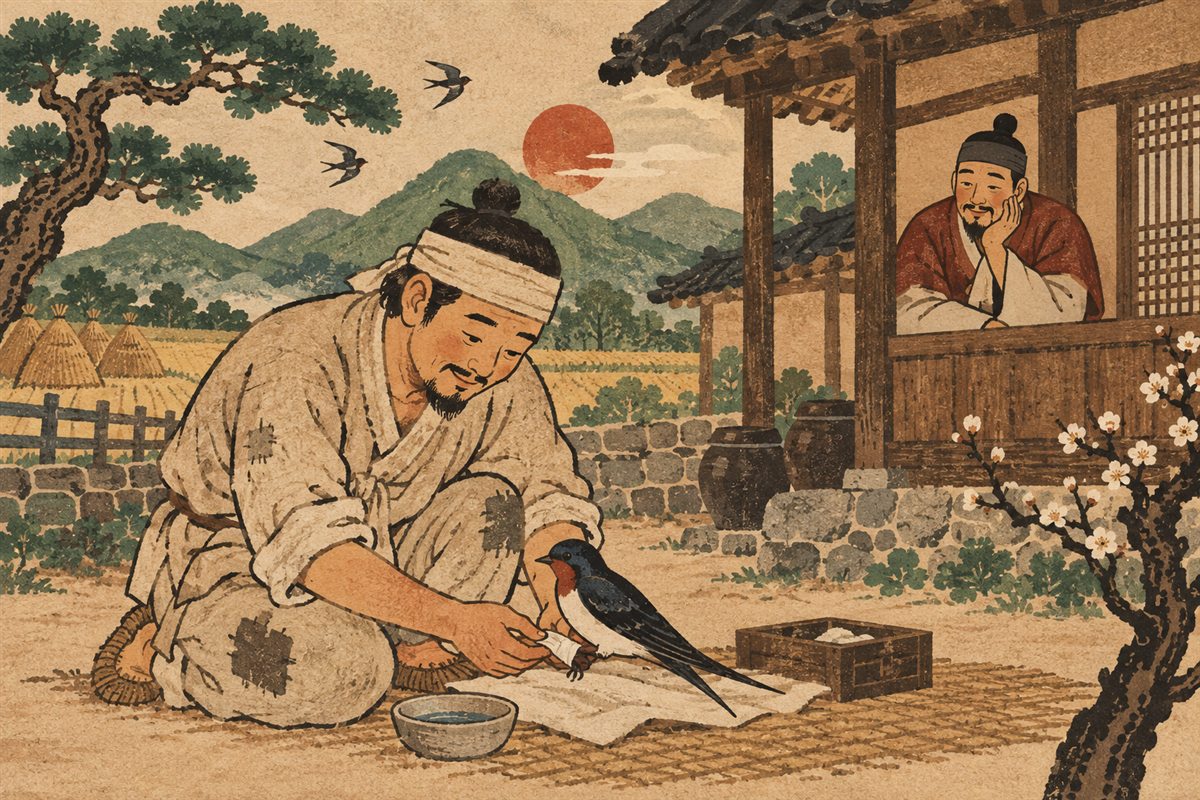
In spring, Heungbo finds a swallow with a broken leg. He wraps the injury with a shell and feeds it small creatures until it heals. The bird flies away. The following spring it returns with a seed marked as a reward for kindness.
Heungbo plants the seed. Twelve gourds grow. He and his wife open them one by one: silver, gold, coins, precious objects, household goods, cloth, servants, and finally a woman who presents herself as his concubine. His household becomes extraordinarily wealthy.
Nolbu visits and hears how Heungbo became rich. He deliberately breaks a returning swallow’s leg, dresses the wound, and waits for his own seed. When it comes, he plants it and prepares lavish food before opening his gourds.
The first gourd releases a former master who claims Nolbu’s family owes service and demands payment in goods. Later gourds release robbers, shamans, and other claimants who take household property or demand money. Nolbu keeps opening them, hoping the next will make him richer. The final gourd is made into soup; Nolbu and his household cry out with a strange “dangdong” illness. Seeking a cure at the local magistrate’s household brings the same comic affliction there, and Nolbu must surrender property. He loses his house and livelihood. Heungbo takes Nolbu and his wife in and shares food and shelter. The text closes with Heungbo’s later rise through the military examination and his descendants’ success, not a simple remorse-and-forgiveness scene.
Korean Context in This Story
Heungbo Manborok is an early written form of a story later circulated in many oral, pansori, and literary versions. Its plot differs from familiar short retellings: parental care frames the brother conflict, the good gourd has twelve distinct openings, and Nolbu’s punishment unfolds through detailed social satire. The 1833 text is treated here as one historical witness, not as the universal form of Heungbujeon.
Versions and Sources
Selected edition: Heungbo Manborok (1833), complete old-Hangul transcription. The twelve gourds contain named wealth and increasingly comic burdens; the final punishment is the “dangdong” illness episode, followed by Heungbo taking Nolbu in and a lineage ending. This differs from modern tellings centered on expulsion, a lucky gourd, and quick brotherly reconciliation. Compare the Academy of Korean Studies account of the many Heungbujeon variants. A Korean-language review is still needed for several archaic lines and exact family relationships in the opening.
Retold in original English prose.
Source and plot checked 2026-10-04. See the source note for whether the basis is a primary text, oral record, or scholarly summary.