Bari-degi and the Life-Restoring Flowers
바리대기 · 바리공주
The daughter her father abandoned is called home when he falls ill. To find his medicine, Bari must leave again—this time for a distant land whose keeper will not give up his secret freely.
Who’s who in this story
- Bari
- The youngest daughter, abandoned by her father after her birth.
- Bari's father
- The lord whose illness brings Bari back to the household.
- Bari's mother
- The parent who calls for her when her father is dying.
- The keeper of the remedy
- The man Bari meets in Seocheon Seoyeokguk.
Story at a Glance
An abandoned child survives in a flower field. Years later, her mother calls for her: her father is dying, and only Bari can bring the medicine he needs.
The Story
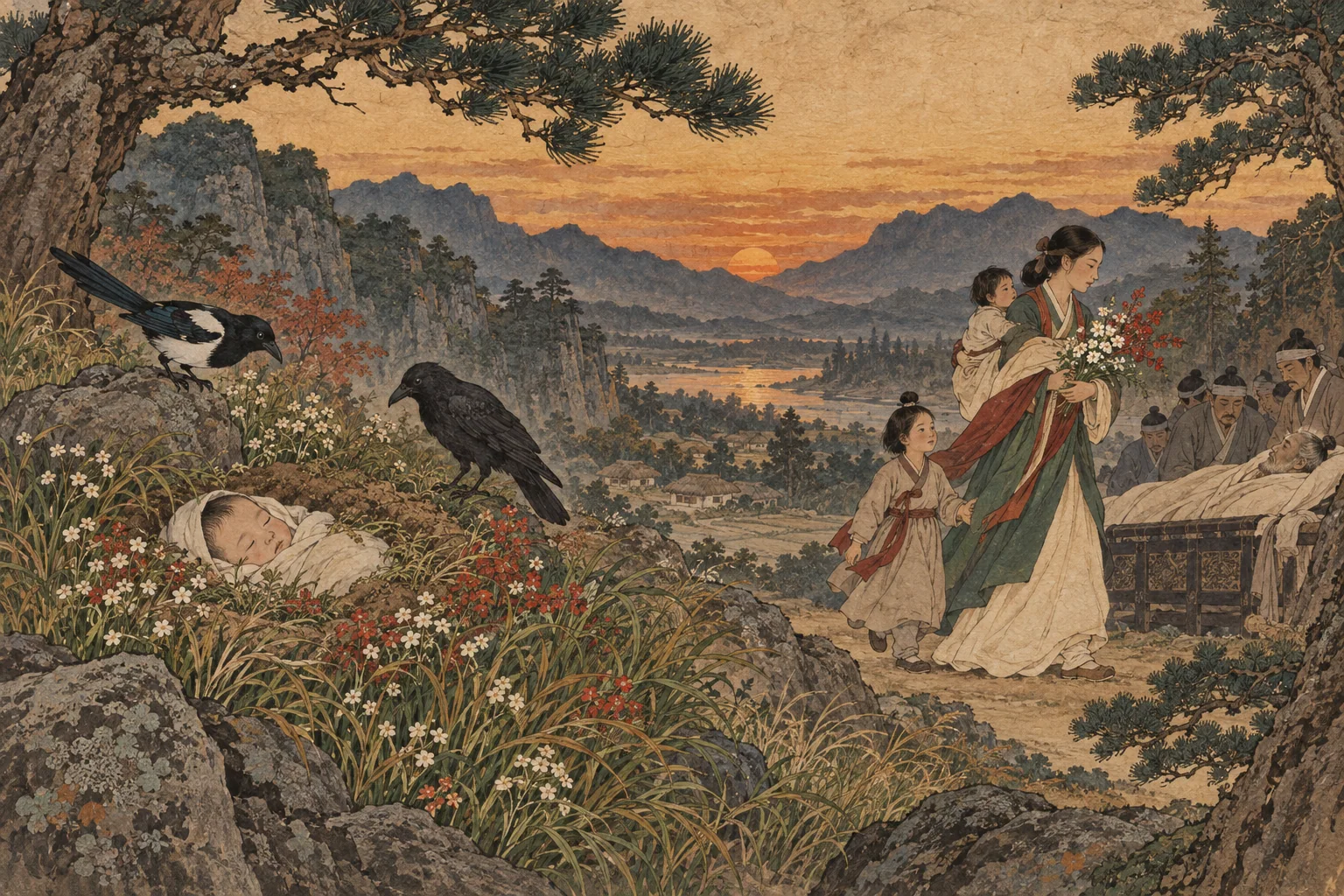
A lord already had daughters when another girl was born into his household. He ordered the youngest child to be taken away and left in a flower field.
The people who carried her there saw crows and magpies nearby and returned to look. The baby was alive, sheltered as though someone had covered her and held her while she slept. They left her there once more. Later, she vanished from the field, and no one knew where she had gone.
Years passed. The father became so ill that the household could find no cure. They learned that medicine might be brought from Seocheon Seoyeokguk, the distant Western Paradise, but the daughter they had abandoned was the one who must fetch it.
Her mother went to the place where the baby had been left. She called for Bari, the abandoned child, and told her that her father was dying. The daughter appeared. The family that had sent her away now asked her to leave on its behalf.
Bari set out in search of life-giving water. In the Western Paradise she met a man who knew where the medicine was kept. He would tell her only if she became his wife. Without his help, she could not get what she had come for. She agreed and remained with him.
Their first child was born. Bari asked about the medicine, but the man still kept it from her. After a second child was born, he finally revealed his garden. What it held was not the water she had been sent to find, but flowers with powers to restore a body to life.
The white flower could restore flesh. The red could restore blood. Other flowers could bring back speech and the remaining powers of the body. Bari had reached the remedy at last.
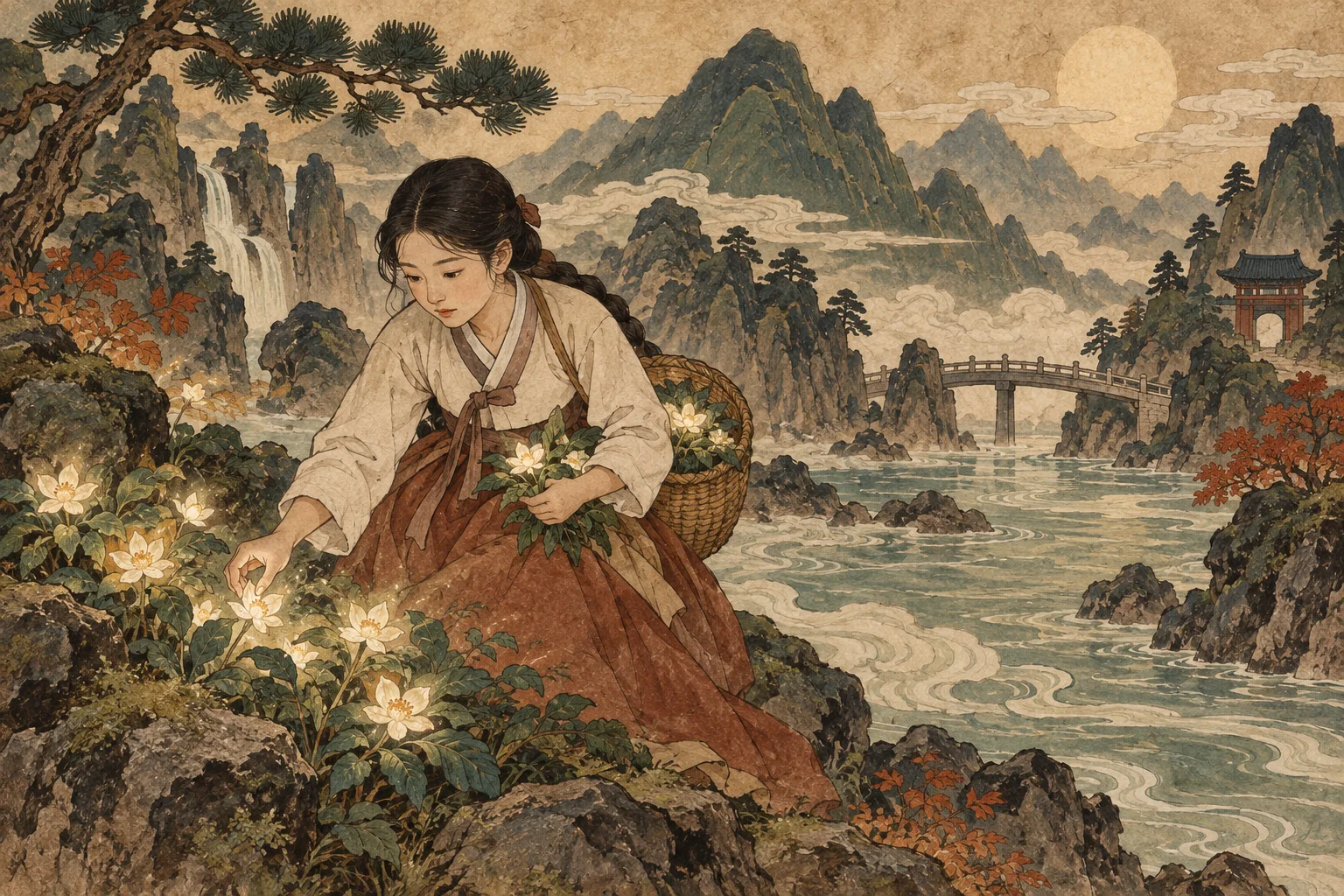
When the man was away, she gathered the flowers and left. One child rode on her back; the other went beside her. She brought both children on the road home.
She arrived to find her father’s funeral already underway. The bier was being carried out. Her sisters rebuked her for returning so late, and the procession would not stop when she called to it.
Bari used her power. The bearers’ feet would not move. The bier could go no farther. She had come with the medicine, and she would not let her father be taken away before she used it.
His body was brought inside. Bari laid the white flower on him, and flesh returned. She placed the red flower, and blood returned. She used the other flowers until he could speak and live again.
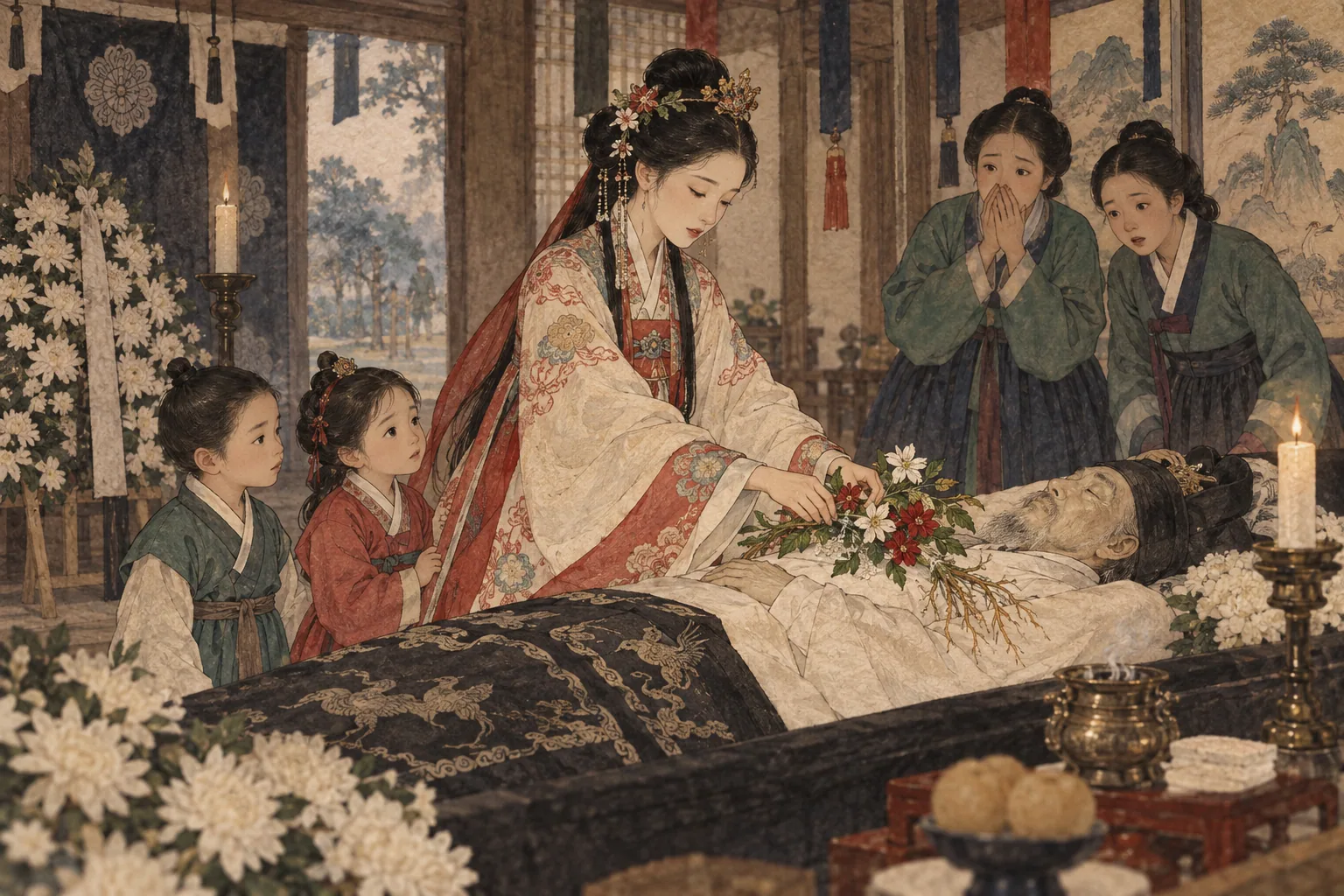
The funeral had become a homecoming. Beside the father who had once ordered her abandonment stood Bari, with the two children she had brought back and the flowers that had stopped his burial.
Korean Context in This Story
Bari is known both as Bari Gongju, Princess Bari, and as Bari-degi, the abandoned child. In shamanic songs performed during rites for the dead, her journey gives a human shape to passage between worlds. Mourners hear of a daughter who goes where others cannot and returns with the means to restore life. Books and stage retellings also draw on her endurance and on the difficult demands made by the family that rejected her. Explore the ritual context →
Bari’s search for medicine can also be read beside hyo, care for parents. Her situation makes that comparison difficult in a useful way: the father who now needs her is the father who abandoned her. The journey brings care and rejection into the same family history. Its place in shamanic storytelling also gives it a ritual dimension beyond a household moral. Read it beside Simcheong to notice how differently two daughters arrive at the decision to help a parent—and how much each has to do before reunion becomes possible.
A Closer Look
Who carries whom on the road home?
At the beginning, others carry Bari out of her father’s household and leave her behind. On the return journey, she carries a child herself and brings another beside her. That reversal makes the homecoming larger than a successful errand: the abandoned daughter returns as a mother, with a life that has continued beyond the family that sent her away.
The medicine also changes as she approaches it. The household sends her for life-giving water, but the garden offers flowers, each with a particular bodily power. White and red turn the abstract hope of a cure into a sequence of actions the listener can picture. By the time the sisters accuse her of lateness, readers know how much the journey has required.
Stopping the funeral gives Bari the authority to finish what she came to do. The procession will not listen to her call, so she makes it physically unable to proceed. The person once excluded from the household now determines whether its father will be buried.
Read next: Simcheong also travels beyond ordinary human life for her father. Daughters Who Change the Ending compares the costs and the very different homecomings.
Versions and Sources
Read about this telling and other versions
This story follows Kwon Bongpil’s “Baeri-daegi,” recorded in 1979. Kwon recalled a shaman’s song learned in the Yangsan–Eonyang area and recounted it in prose. The child disappears from the field and reappears when her mother calls; the record does not describe who raised her. Bari has two children, leaves while the garden’s keeper is away, and stops the funeral bearers with a spell. The white flower restores flesh and the red restores blood.
Regional versions have different parents, helpers, journeys and endings. The Academy of Korean Studies overview of Bari-degi describes these traditions. Episodes from other versions are not inserted into this account.