Guiding the Dead in Korean Shamanic Rites
망자천도굿
Meet Bari as a guide between worlds, learn where her story is sung, and discover how a ritual song differs from a folktale on the page.
Why Sing about Bari When Someone Has Died?
In Korean shamanic traditions, Bari is known as a guide who leads the dead toward the afterlife. Singing her life story explains why she belongs in a rite concerned with that passage. For a reader who first meets her as an abandoned daughter searching for medicine, this is another way to understand the journey: it also gives a compassionate guide a history.
A gut is a shamanic rite. Rites for the dead seek to help a spirit leave this world; their purpose belongs to the beliefs of the communities practising them. Bari’s place in some of these traditions does not mean that every Korean funeral includes her story.
A Story Carried by a Voice
The term muga means a shamanic song. A seosa-muga is a narrative song: it has characters and a sequence of events, and may explain the origins of a deity. In performance, a story unfolds through a practitioner’s voice and instrumental accompaniment before listeners. Its place in a rite matters as much as its plot.
The Academy of Korean Studies describes practitioners learning from teachers and predecessors, then reshaping inherited material in their own language during performance. This helps explain why a living tradition can preserve a recognizable journey without producing one fixed script. A change in an episode need not mean that someone has failed to remember a standard book.
Three Regional Names to Recognize
These names can help you understand a recording’s description. They identify related settings for Bari narratives, rather than interchangeable names for an identical performance:
- Seoul — Jinogi-gut: Bari’s story is associated with the Malmi section.
- Honam — Ssitgim-gut: related narratives are known as Ogu-puri.
- East coast — Ogu-gut: the story is associated with Barwon-gut.
The heroine may be called Bari Gongju, Princess Bari, or Bari-degi. Regional tellings also change the people she meets and the remedy she brings home. Our Bari story follows a Gyeongsang prose recollection in which flowers restore her father. That ending is a useful point of comparison when you encounter a song about life-giving water.
See a Regional Rite in Performance
The public KTV e-History archive’s “Jindo Ssitgim-gut” clip runs 1 minute 8 seconds. It comes from a newsreel dated 5 November 1983 and shows a performance at the 14th Intangible Cultural Heritage Masters’ Festival. The accompanying description explains the rite’s concern with easing the dead person’s unresolved grievances.
Use it as a brief visual encounter with a regional ritual performance. It is festival footage, and the archive does not identify it as a performance of Bari’s narrative. Start with the voices, instruments, and arrangement of people; the clip’s short length cannot convey the sequence of a whole rite.
Return to the Daughter’s Journey
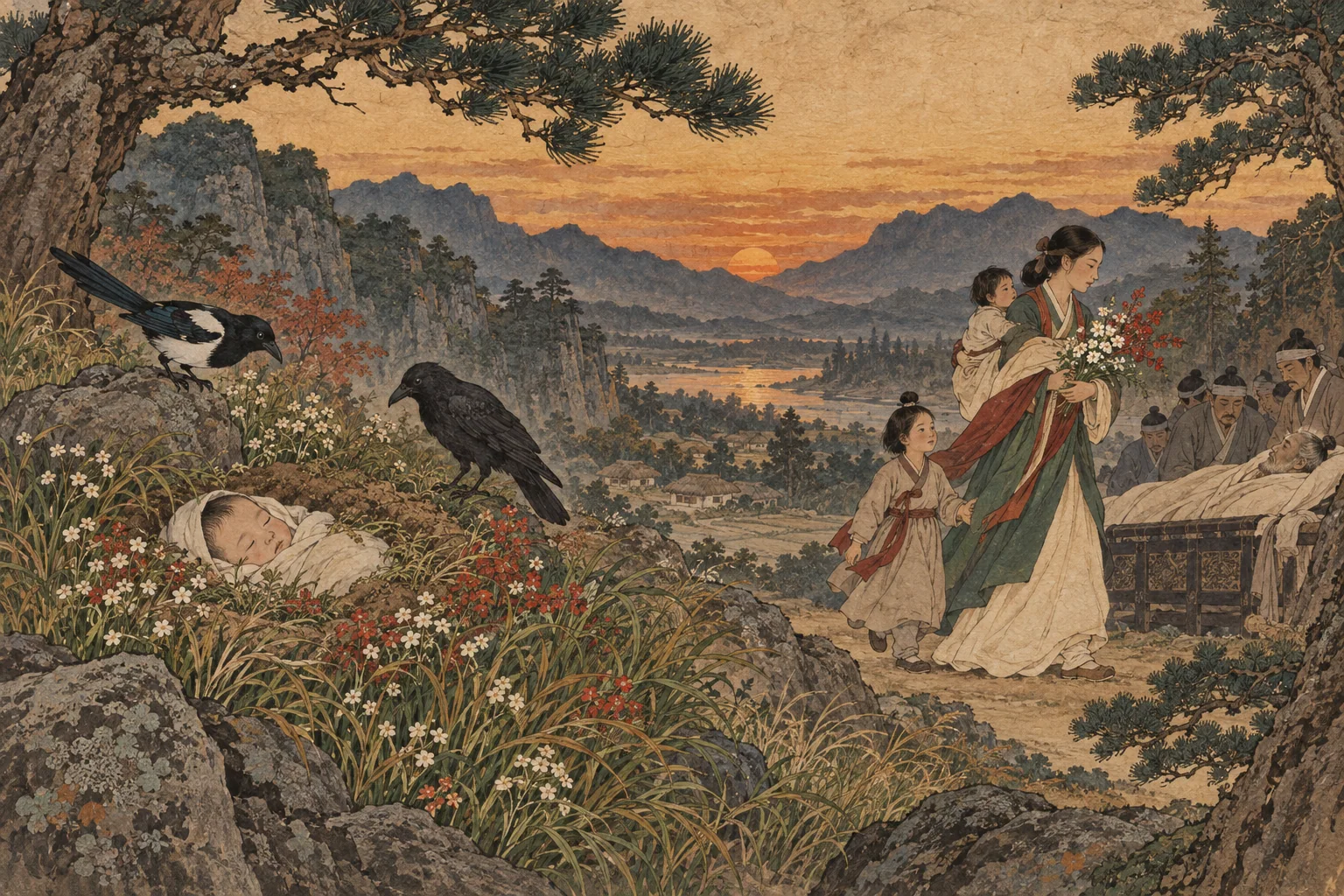
After learning this background, reread the moment when Bari stops her father’s funeral. On the page, it is a dramatic interruption: the procession will not listen, so she prevents it from moving. Beside the tradition of Bari as a guide, it also invites a question about who has the authority to cross a boundary between life and death.
Compare Simcheong, another daughter who returns from beyond ordinary human life. Her story also belongs to pansori, a different performance tradition. Hearing about both opens two routes from a written tale toward the voices that carry Korean stories.
Further Reading
Explore the songs, regional traditions, and recorded telling
- Bari-gongju, Academy of Korean Studies: Bari’s ritual role, regional names, and differing journeys; includes performance photographs.
- Narrative Shamanic Songs, Academy of Korean Studies: what makes a narrative song and how practitioners transmit it.
- Kwon Bongpil’s “Baeri-daegi,” Korean Oral Literature Compendium: the 1979 prose recollection behind our story. Kwon said she had learned it from a shaman’s song in the Yangsan–Eonyang area.