Bari-gongju
바리공주
In rites for the dead, Bari is invoked as a guide who helps the deceased travel to the afterlife; her story has distinct regional tellings.
Quick Summary
Bari-gongju (바리공주), also known through regional names such as Bari-degi and Biridegi, is the heroine of a long narrative sung or recited in Korean shamanic rites for guiding the dead. In those ritual traditions, she is understood as a spirit who leads the deceased toward the afterlife. Details of her story differ among regional versions.
A Figure in Ritual Narrative
The Academy of Korean Studies describes the story as a seosa-muga, a narrative performed by a shaman. Seoul traditions call it Malmi; versions in the Honam region are known as Ogu-puri, and east-coast rites include it in Balwon-gut. More than one hundred versions have been recorded, with a shared outline and regional differences.
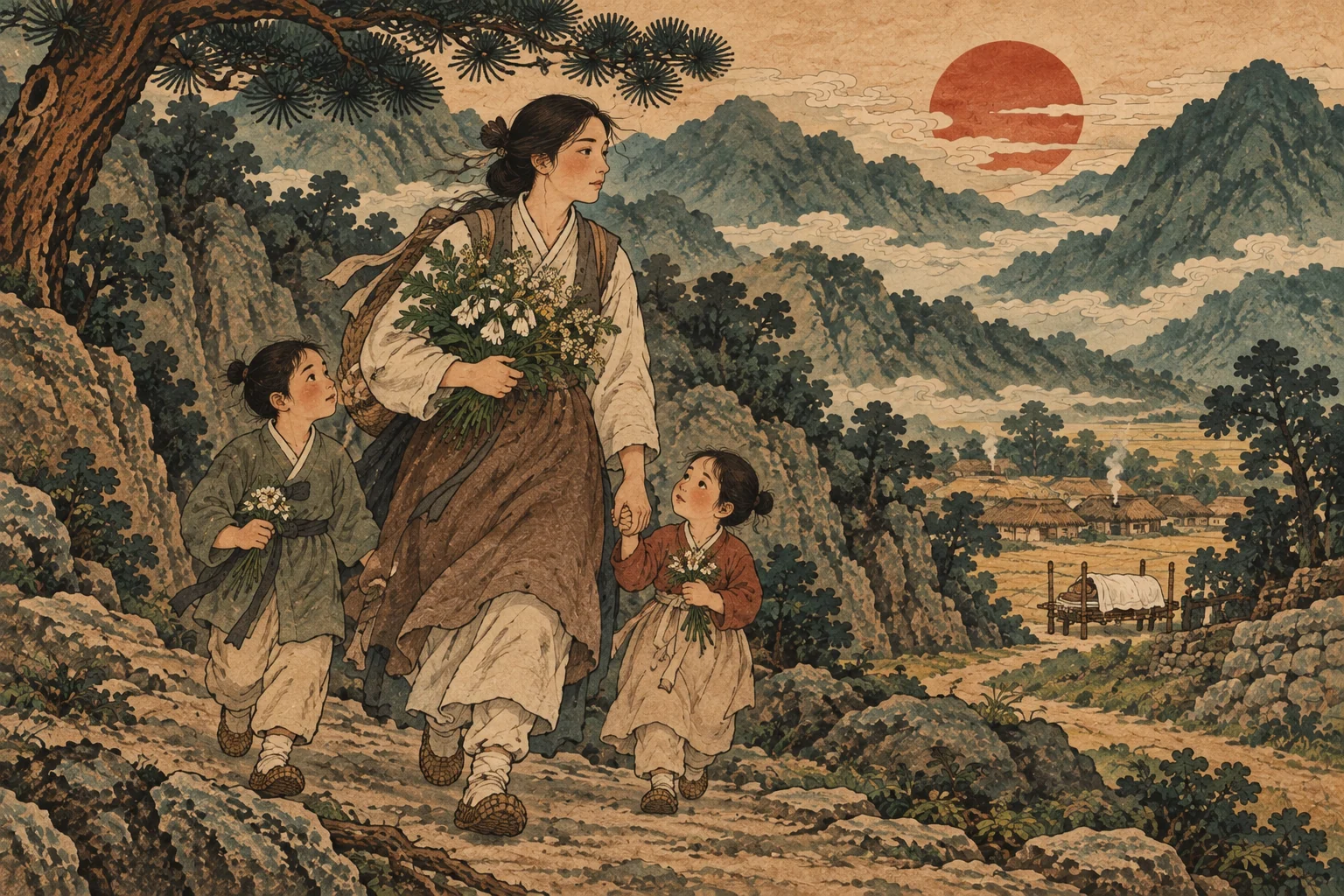
In the selected Gyeongsang telling, the youngest daughter is abandoned, later returns to find medicine for her dying father, and uses restorative flowers at his funeral. The story page follows the words and limits of that recorded account; it should not be treated as a universal script for every Bari rite.
Princess, Abandoned Child, and Guide
The English name “Princess Bari” draws attention to status and family. “Bari-degi,” commonly rendered as the abandoned child, draws attention to what happens to her. Both point toward the same broad narrative tradition, but they lead a first-time reader to expect different things: a princess’s adventure or an excluded child’s return.
In the telling linked here, the abandonment is not just an opening hardship. It makes the later request for medicine a reversal. The father who sent the daughter away needs her to travel on his behalf. Her return with two children and restorative flowers puts the family’s dependence on her at the center of the funeral scene.
Why the Ritual Role Extends Beyond This Ending
The selected prose telling ends with the father’s restoration. The broader ritual tradition understands Bari as a guide of the dead. Those are related layers of her significance, but the individual record does not narrate every step of that role. You can read her flower-gathering adventure on its own, then use the Jinogi-gut guide to understand why her journey also matters in rites concerned with death and passage.
For a comparison centered on family rather than ritual, read Bari beside Simcheong. Both daughters go beyond ordinary human life for their fathers, with distinct costs and returns.
Sources
- Academy of Korean Studies, Encyclopedia of Korean Culture: Bari-gongju (ritual setting, regional names, and version differences).
- Korean Oral Literature Compendium, “Baeri-daegi,” POKS.GUBI.GUBI.1_8465 (the selected Gyeongsang account).