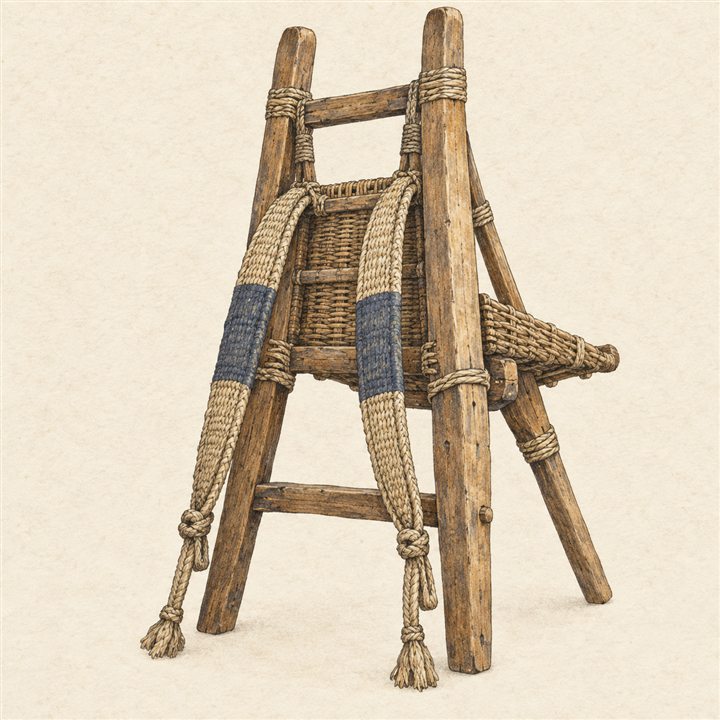
Jige (Back Carrier)
지게
A traditional Korean frame carrier worn on the back to transport loads.
Research note · see sources and scope belowOne-Sentence Definition
Jige (지게) is a traditional Korean frame carrier worn on the back to move loads.
What It Looked Like
The Academy of Korean Studies describes a frame commonly built from two forked wooden uprights joined by crosspieces. Shoulder straps transferred the load to the wearer, a straw back pad could protect the back, and a detachable stick propped the carrier upright during a rest. The illustration shows only a broad A-frame; real dimensions and fittings varied with the maker, the wearer, and the load.
Where It Was Used
The jige carried firewood, grain, manure, and many other loads. Regional versions differed: frames used in steep mountain terrain could be shorter to avoid rocks and brush, while longer frames were useful on flatter land and easier to set down for a rest. Some communities adapted the frame for fish, water, tools, or trading goods. These are examples of a flexible carrying tool, not one universal model.
How It Appears in Folktales
No Atlas story currently identifies a jige as a plot object. A rural setting alone does not establish that the carrier appears in the source. The National Folk Museum documents the Gongju Seonhak-ri Jige Play, a local performance that grew from the tool’s importance in a mountain village’s farm and firewood work. That performance is a specific village tradition, not a national festival or a complete history of the carrier.
Sources
- Academy of Korean Studies, Encyclopedia of Korean Culture: Jige (construction and regional forms).
- Academy of Korean Studies, Encyclopedia of Korean Culture: Agricultural Tools (regional and task-specific adaptations).
- National Folk Museum of Korea, Gongju Seonhak-ri Jige Play (one local performance tradition).
Stories featuring Jige (Back Carrier)
This guide provides cultural background. No current story page names this item as a direct plot detail, so the Atlas keeps the two separate.