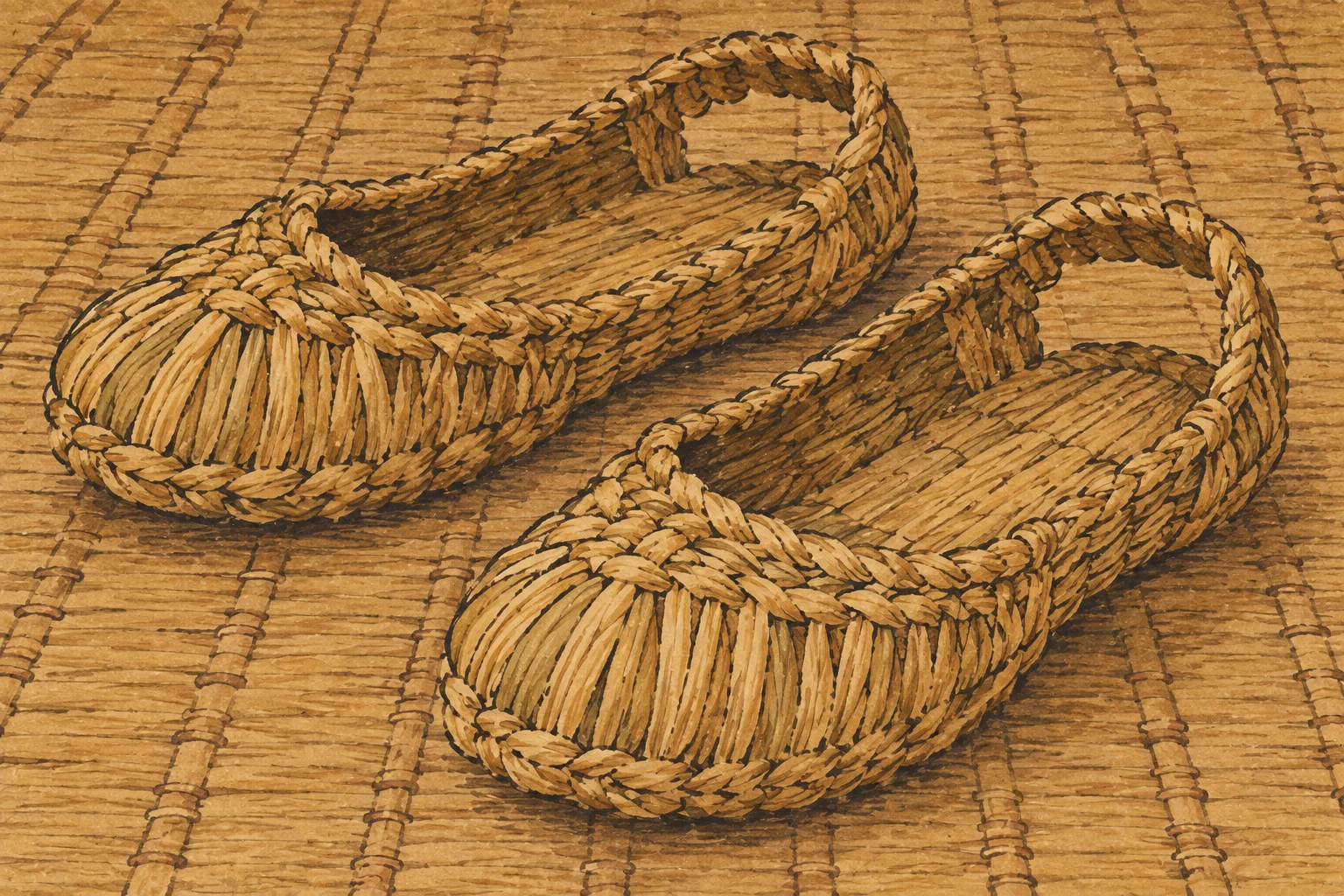
Jipsin (Straw Shoes)
짚신
Explore the woven construction of Korean straw shoes and the contrast between handmade footwear and a heavenly garment in The Fairy and the Woodcutter.
Shoes Made by Braiding
Jipsin (짚신) are shoes woven from rice straw. A maker twists fibers into cords, works a sole to fit the foot, forms the sides, and binds the upper edge. Looking at those parts reveals a made object, rather than simply a rustic costume detail.
The Academy of Korean Studies records their use for field work and long journeys. It also distinguishes shoes made from hemp, sedge, kudzu, and bulrush. These materials belong to a wider family of plant-fiber footwear.
Three Things to Look For
Start with the sole: where do the cords turn and join? Then follow the sides, which keep the foot within the shoe. Finally, look at the upper binding that holds the construction together.
The encyclopedia’s gallery includes shoes, tools, a weaving frame, and images of making them. Seeing a shoe beside its tools makes the work easier to imagine than looking at the finished pair alone.
The Quiet Moment in the Woodcutter’s Story
In the Jindo telling of The Fairy and the Woodcutter, the man is making straw footwear on a rainy day when he reveals the secret of his wife’s heavenly clothes. The telling names the activity without specifying a particular weave.
The scene changes the story’s scale. After the extraordinary meeting at the mountain pond, years of household life have passed. A practical task gives the confession an ordinary setting. Then the hidden clothes return, and that ordinary life ends.
Put the two kinds of clothing side by side: the shoes are something he can make with his hands; the heavenly garment lets his wife go where he cannot follow on foot. Everyday work and supernatural movement meet in the same conversation.
Follow the Journey
Compare the woodcutter’s footwear with the supplies placed for an afterlife messenger. In the southern Gyeonggi custom described there, straw sandals accompany food and coins for a different kind of departure.
Further Reading
- Academy of Korean Studies, Jipsin, including construction, uses, and the making-tool gallery.
- Korean Oral Literature Compendium, The Woodcutter and the Heavenly Maiden, Jindo, 1979.