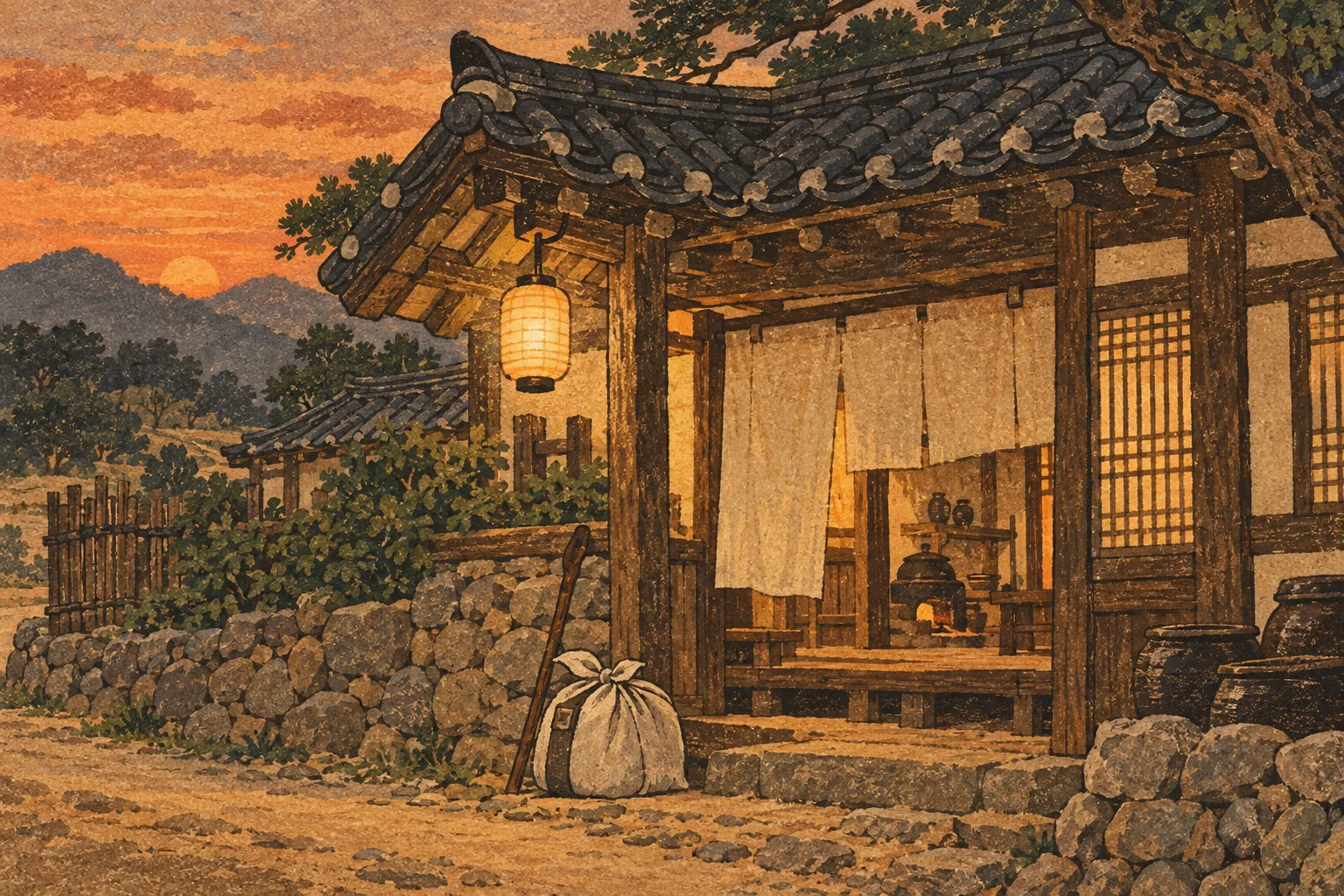
Jumak (Roadside Inn)
주막
Food, rest, and unexpected company on the road: explore the Korean inn and an anecdote in which a traveler misjudges a powerful stranger.
Where the Road Pauses
A jumak (주막) combined the functions of a drinking place, an eating place, and, in some establishments, lodging. It could serve a traveler passing through or people gathering close to home.
Think of it as a stopping point with several possible purposes. “Inn” explains only part of the word, while “tavern” can hide the importance of food and rest.
Why Here?
Historical examples stood near markets, ferry crossings, major roads, and passes. Such places brought different travelers together. A large establishment could have rooms, storage, and a stable; a modest inn might have only a few rooms and a drinking counter. Some temporary roadside businesses opened only by day.
Their role in exchanging information followed from that traffic. People who had traveled different stretches of road could meet at the same stop.
A Small Story about Judging a Stranger
The Academy of Korean Studies recounts an anecdote associated with Maeng Sa-seong, a senior official. At an inn, a man heading to an examination makes light of the plainly dressed stranger. The later meeting at the examination reverses their positions: the man discovers whom he has been addressing.
The inn gives the anecdote its useful uncertainty. Away from the formal setting of office, appearances can mislead. A shared stop brings people together before they know one another’s standing.
Compare the Scholar’s Night Stop
In The Grateful Magpie, the scholar takes shelter at a temple, not a jumak. His night is shaped by the temple bell. The kind of stopping place changes what can happen next: a reader who treats every shelter as an interchangeable inn misses the object on which his rescue depends.
Read next: Gwageo, the Government Examinations, for the destination behind many scholars’ journeys.
Further Reading
- Academy of Korean Studies, Jumak, for historical locations, services, and the Maeng Sa-seong anecdote.
Continue through Village Life in Traditional Korea →
Experience Korean culture
Visiting Korea? Explore an experience connected with what you’ve just read.
Step into Korean village life
Explore traditional houses, crafts and performances at Korean Folk Village. Its recreated village setting offers another way to encounter the everyday culture behind these stories.
Craft demonstrations and performance schedules vary by date.
View village tickets on Klook (opens in a new tab)Affiliate links: we may earn a commission if you book through these links, at no additional cost to you. Klook handles bookings, availability and prices. About our recommendations.