The Grateful Magpie
은혜 갚은 까치
A scholar frees a magpie from a snake on the road to Seoul. Before dawn, the same snake is coiled around him, and a bell he cannot reach must ring three times.
Who’s who in this story
- The scholar
- A traveler on his way to take the government examination in Seoul.
- The magpie
- The bird the scholar saves from a snake along the road.
- The snake
- The same snake, which later coils around the scholar and speaks of becoming a dragon.
Story at a Glance
On his way to take an examination, a scholar stops to save a bird. At a temple that night, his own life depends on help he has no way to summon.
The Story
A scholar who had spent long hours studying set out for Seoul to take the civil-service examination. The road to the capital led him through the mountains. He traveled on until daylight was running out. Hungry and still far from a place to stay, he began looking for somewhere to spend the night.
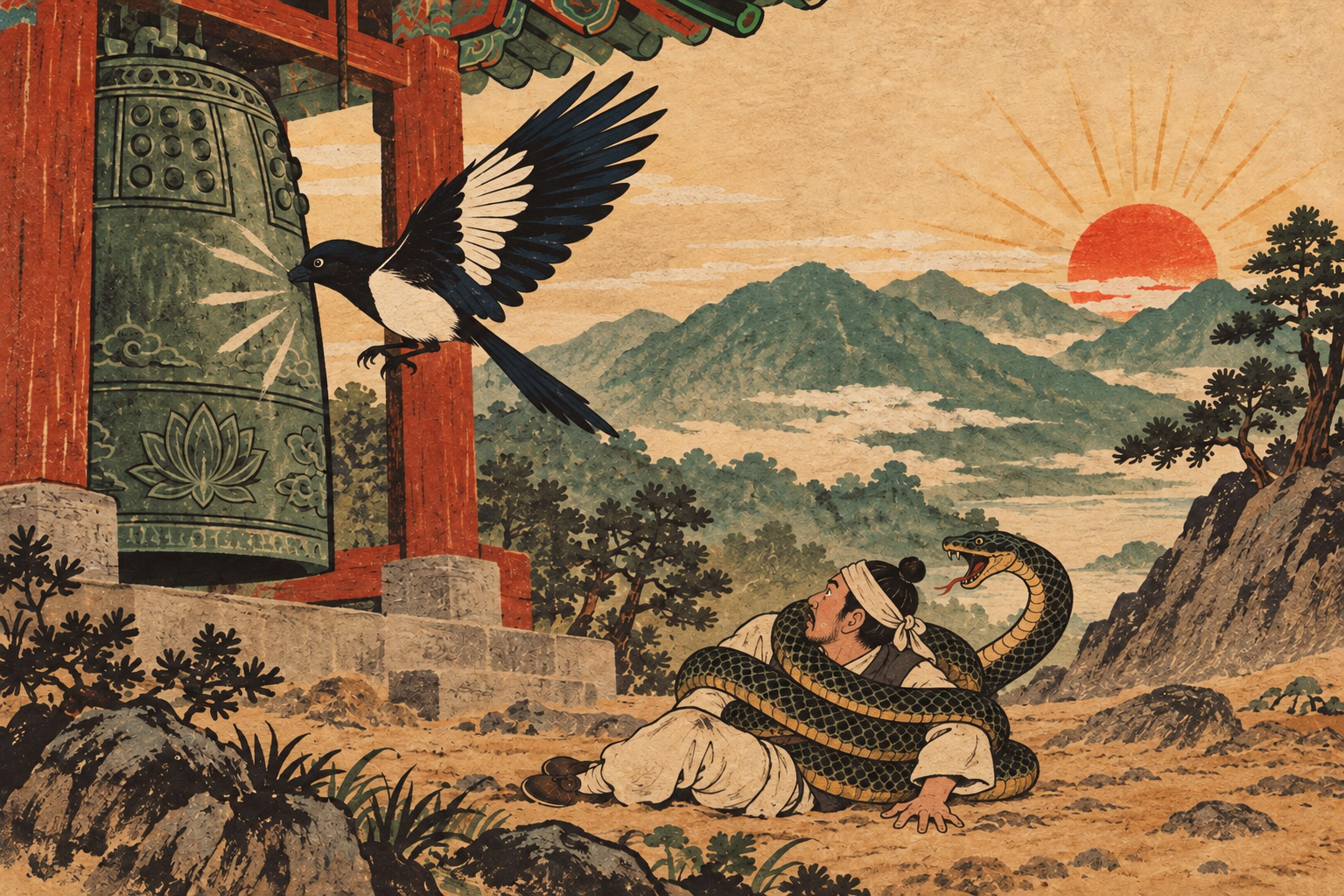
A magpie’s cries interrupted his search. He looked up and saw a large snake trying to eat the bird. The scholar raised his bow and shot at the snake. It fell, and the magpie flew free. The encounter was over; he continued along the road.
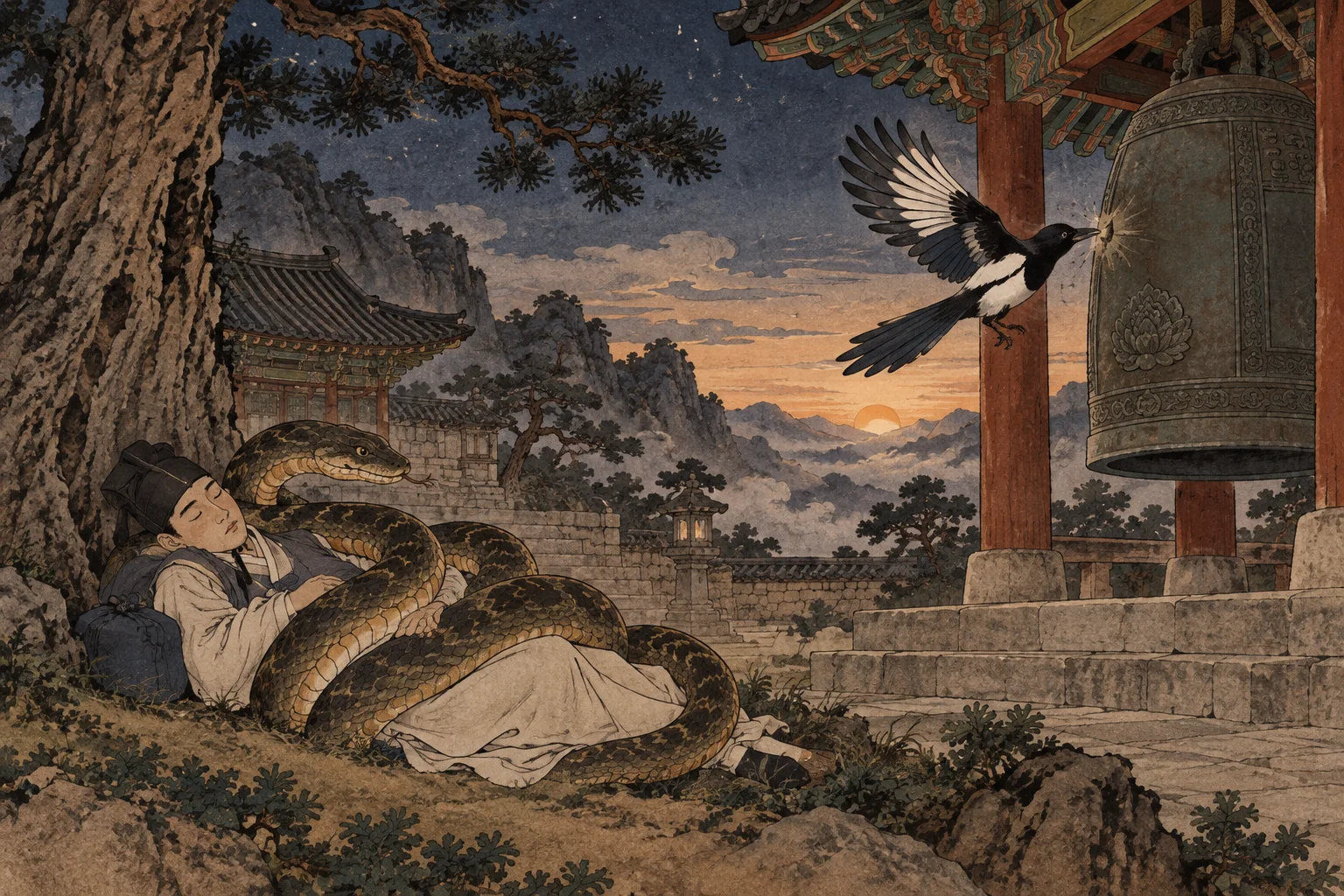
At last he reached a temple. Here he could stop traveling and lie down for the night. He went to sleep, leaving the danger on the road behind him.
Before dawn, he woke struggling for breath. Something was wound tightly around his body, reaching up about his neck. He opened his eyes. The snake he had shot was there, coiled around him. The creature he had driven away from the bird now held him where he lay.
The scholar begged to be spared and asked why the snake had come. It told him that it could become a dragon if it heard the temple bell ring three times.
There was a bell at the temple, but he could not reach it. He was trapped in the coils, unable to make the sounds the snake had spoken of. Three strokes of a bell might change what happened next. From where he lay, they seemed impossible. He thought he was going to die.
The magpie he had saved reached the bell. The scholar could not get there; the bird could. It struck the bronze with its head.
The bell rang once.
The bird struck again. A second ring sounded.
It struck a third time. The last sound rang out, and the magpie fell to the ground beneath the bell.
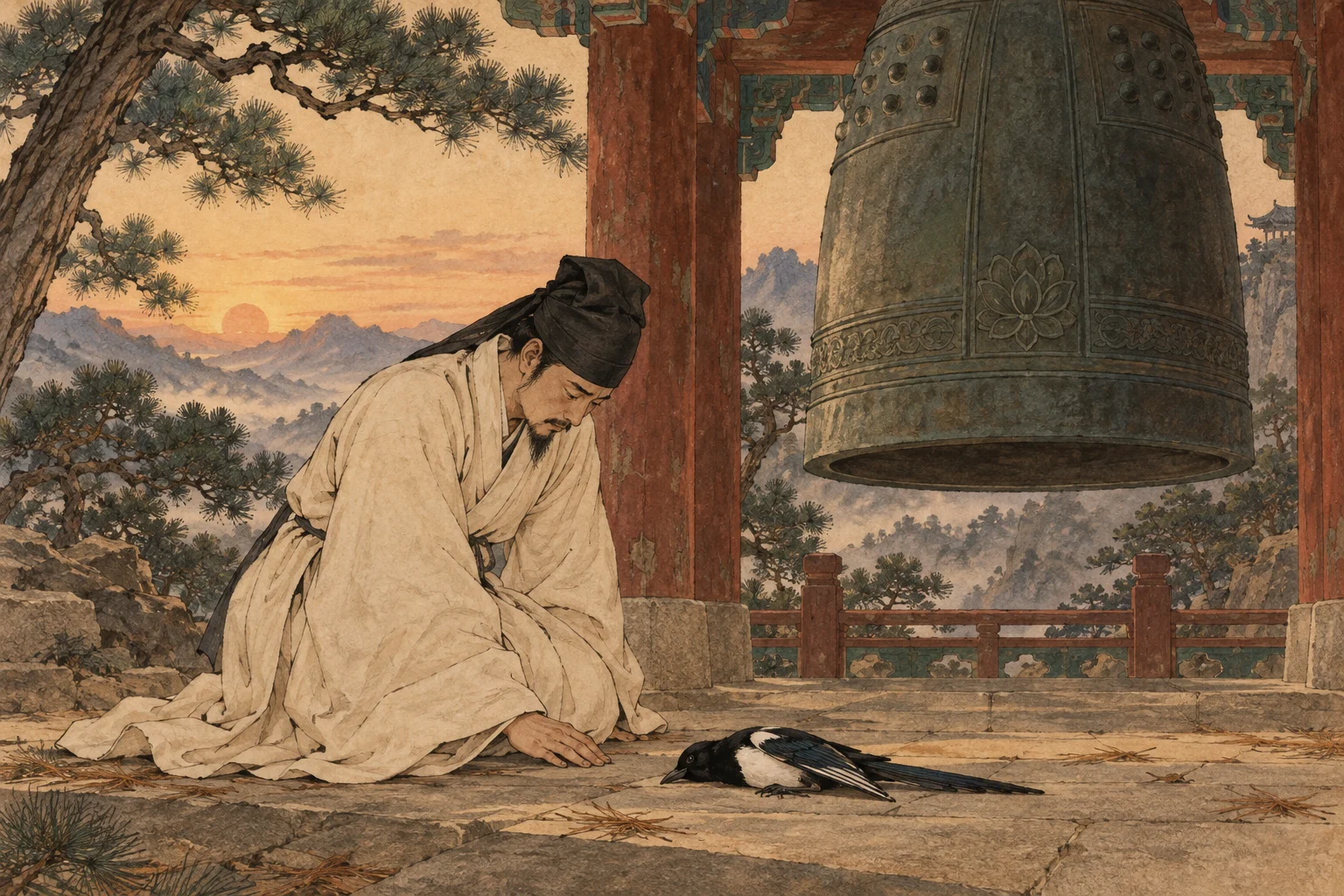
The snake loosened its coils. The scholar was free. He went to the bell, where the three sounds that had released him had come from, and found the magpie lying dead beneath it.
On the road he had stopped, drawn his bow, and gone on with his journey. The bird’s return of that kindness had cost its life. He looked at the small creature he had rescued and thanked it. He was alive because it had come back to help him.
Korean Context in This Story
Many Koreans meet the grateful magpie in childhood stories or school readings. The image of a small bird striking a temple bell makes the return of a favor unforgettable. The tale gives concrete form to eunhye, a kindness received and remembered: the rescued creature becomes the rescuer. Different local tellings change the traveler, the number of birds, and the snake’s part, while the bell remains the moment audiences wait for.
The government examination system, or gwageo, explains why a scholar would leave home for the capital. It points toward a possible career, but the tale turns his attention elsewhere. Once he has saved the magpie, a different obligation follows him along the road. Compare his journey with Mongryong’s in Chunhyang: one story returns to official power, while this one leaves the reader beside a bell and a bird whose kindness cannot be repaid.
A Closer Look
The rescued creature becomes the rescuer
The scholar’s bow lets him help the magpie from a distance. Later, when the snake holds him, neither learning nor a weapon offers a way out. He needs something beyond his reach: the sound of a bell. The bird can get to it, but making that sound requires its own body. The exchange of favors is deeply unequal in its cost.
Three strikes give the rescue a rhythm listeners can anticipate. Each ring takes the scholar nearer to freedom and the magpie nearer to death. The discovery beneath the bell prevents the release from becoming an uncomplicated happy ending. Gratitude arrives together with grief.
The snake’s account of becoming a dragon also keeps the scene stranger than a simple contest between a good bird and an evil serpent. Freedom depends on the ringing, but this telling leaves the snake’s ultimate fate unsettled. The scholar’s thanks, directed toward the dead bird, is the ending we are given.
Read next: Heungbu and Nolbu offers a gentler return of animal kindness. Comparing the swallow’s seed with the magpie’s sacrifice shows how differently a story can measure a favor.
How Other Tellings Change the Story
Was the traveler a scholar or a hunter?
Two recorded tellings give the bell very different approaches. The 2009 Pyeongchang record is the story retold above; the 2013 Yesan record follows a hunter.
| Detail | Pyeongchang, 2009 | Yesan, 2013 |
|---|---|---|
| The traveler | A scholar heading to the examination in Seoul, carrying a bow. | A hunter carrying a gun. |
| The later threat | The same snake coils around the scholar and speaks of becoming a dragon. | A woman revealed as the killed snake’s wife seeks revenge. |
| The bell | The rescued bird strikes it three times and dies. | The rescued bird also rings it three times and dies. |
The first teller does not recall the snake’s final fate. The second telling explains the threat through revenge. Keeping them separate lets each encounter follow its own logic.
Versions and Sources
Read about this telling and other versions
The main story follows Baek Sun-ja’s 2009 Pyeongchang recording. It ends with the scholar freed, finding the dead bird and thanking it. Baek does not remember whether the snake then leaves or becomes a dragon; no outcome for the snake is supplied here.
A 2013 Yesan recording by Go Won-seok uses a hunter with a gun and a snake’s widow who seeks revenge. It is a different performance, not a continuation of this scholar’s story.