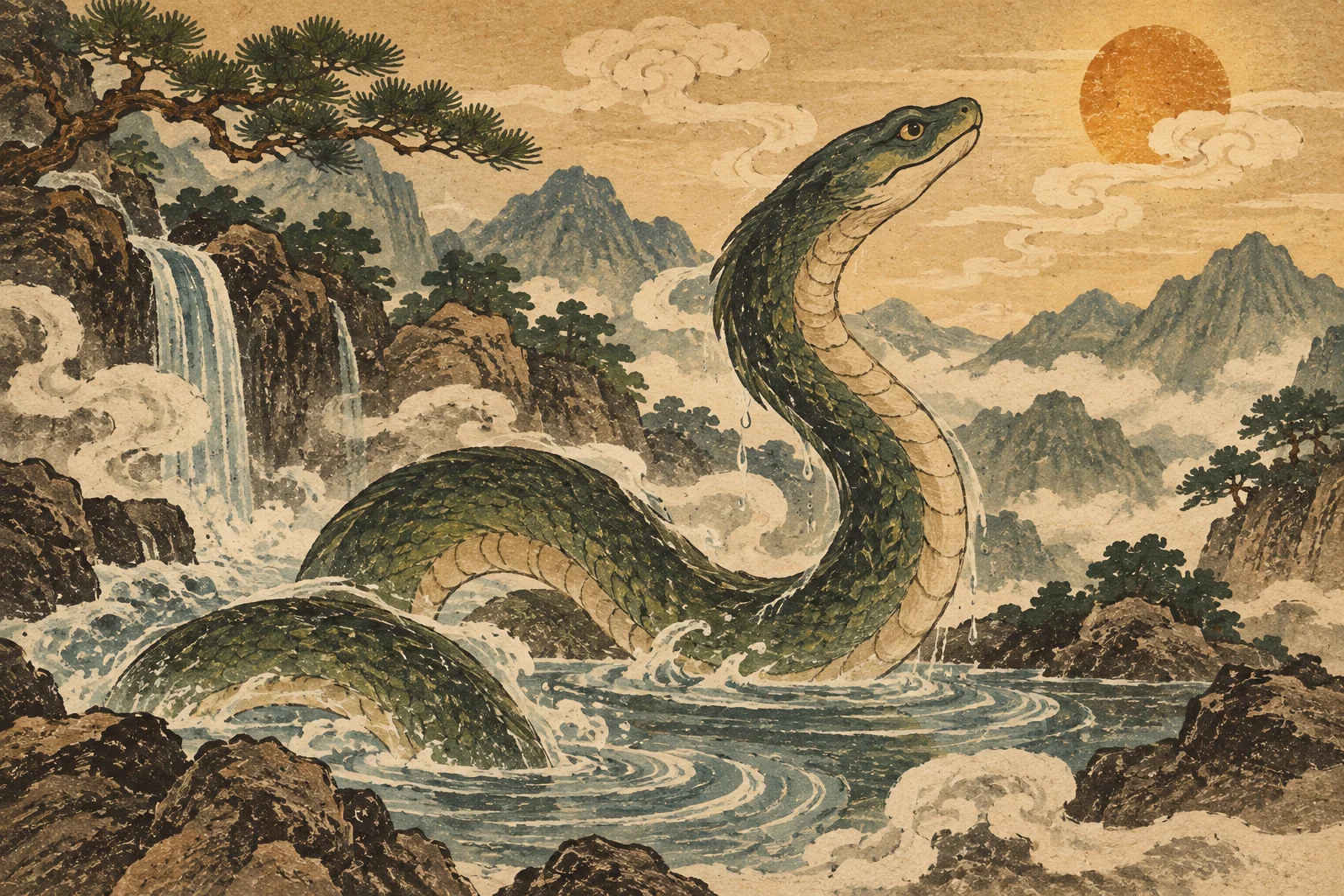
Imugi
이무기
A serpent-like being in some Korean accounts, sometimes connected with becoming a dragon; the motif has more than one form.
Research note · see sources and scope belowQuick Summary
Imugi (이무기) is used for a legendary being associated in some accounts with a serpent and with the possibility of becoming a dragon. The details vary across tellings; a single transformation rule should not be assumed.
A Motif with Variants
The word is often explained to English readers as a serpent-like being that may become a dragon. The Academy of Korean Studies’ dragon entry records older descriptions that connect imugi with a young dragon or a stage in a dragon’s development. These descriptions come from particular textual and visual traditions; they do not establish a single life cycle followed by every being called an imugi.
An expression recorded by the National Folk Museum, “a failed imugi that did not become a dragon,” is used figuratively for someone who has ability or ambition but ends up doing harm instead of achieving a respected goal. A proverb is evidence about how the image can be used in language, not a zoological description of a creature.
Imugi and Dragons
Imugi is often glossed as a “proto-dragon” for readers encountering the term in English. This is an explanatory shortcut, not a claim that every imugi is simply an immature dragon or that all Korean dragon traditions follow one lifecycle.
Editorial Status
No current story in the atlas features a sourced imugi account. We will add story links only when a particular telling supports them.
Sources
- Academy of Korean Studies, Encyclopedia of Korean Culture: Dragon (textual and visual descriptions that connect imugi with dragon traditions).
- National Folk Museum of Korea, reference entry for the expression “a failed imugi that did not become a dragon”.
Stories featuring Imugi
No current Atlas retelling directly features this being. The guide summarizes documented cultural or narrative material without inventing a story link.