Onggi (Korean Earthenware)
옹기
A broad category of Korean earthenware vessels associated with food storage and everyday use, with forms and finishes that vary.
Research note · see sources and scope belowOne-Sentence Definition
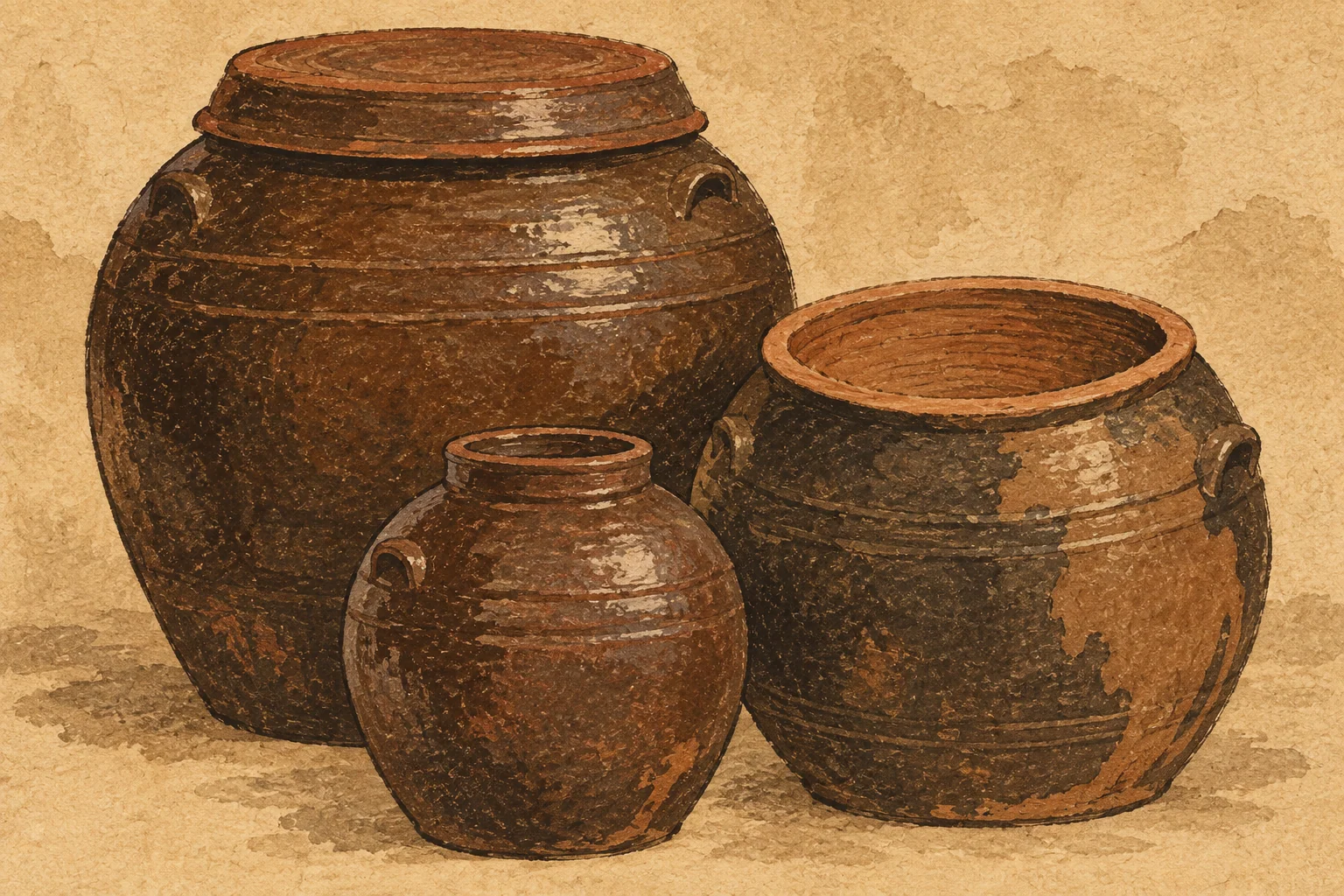
Onggi (옹기) refers broadly to Korean earthenware vessels. Jars are especially familiar in discussions of storing and fermenting foods, but the word should not be reduced to one jar shape.
Material and Use
The Academy of Korean Studies describes onggi as a broad group of vessels whose uses extend beyond food jars: household examples included storage and fermentation vessels, water jars, lamps, braziers, and other tools. It identifies porosity, storage, and fermentation as important characteristics of many forms. The precise performance still depends on the clay body, firing, finish, and vessel, so “breathable pottery” is a useful shorthand rather than a guarantee about every object.
Onggi grew more widespread in everyday life through the eighteenth and nineteenth centuries, while shapes and decoration varied by region. The category therefore describes an important material tradition, not one standard brown jar. A close-up illustration can suggest a surface and shape, but it cannot stand in for the many forms or workshops behind the term.
Onggi and Jangdokdae
Large storage jars for sauces and fermented foods could be arranged on a jangdokdae, the household jar area. The two terms describe different things: onggi is a vessel category; jangdokdae is a place or arrangement. An onggi vessel could also serve a purpose unrelated to the jar platform.
Sources
- Academy of Korean Studies, Encyclopedia of Korean Culture: Onggi (properties, uses, and regional variation).
Stories featuring Onggi (Korean Earthenware)
This guide provides cultural background. No current story page names this item as a direct plot detail, so the Atlas keeps the two separate.