The Sun and Moon Siblings
해와 달이 된 오누이
Their mother is late returning home. When a strange voice calls at the door, her two children ask questions—but the visitor has an answer for everything.
Story at a Glance
Two children wait at home while their mother works for food. A tiger intercepts her on the road, then comes to their door pretending to be her.
The Story
A widow lived with her daughter and son. She earned their food by weaving for other households. One day, after the work was finished, she was given a pot of red-bean porridge. She carried it home for the children.
A tiger met her on the road. It wanted to know what she was carrying. When she told it, the tiger demanded a bowl of porridge and promised not to eat her if she gave it one.
She gave it the porridge and went on. Beyond the next hill, it met her again with the same demand. Another bowl, and she could pass. Hill after hill, the tiger took what she had brought for her children. When the pot was empty, it did not keep its promise. It turned on the mother and devoured her.
The children were still waiting at home. The tiger came to the house and called for them to open the door.
The voice did not sound right. Their mother did not speak like that. The visitor answered that her day’s weaving work had changed it.
The children asked to see a hand. The tiger pushed one in. It was rough and hairy. Again they protested: this was not their mother’s hand. Again the visitor had an explanation. The paste used in weaving had made it rough.
The tiger got inside. The boy saw it and was frightened. He said he needed to go outside to relieve himself. The tiger told him to do it indoors. He insisted that he could not, until at last it let him go out. His sister went with him.
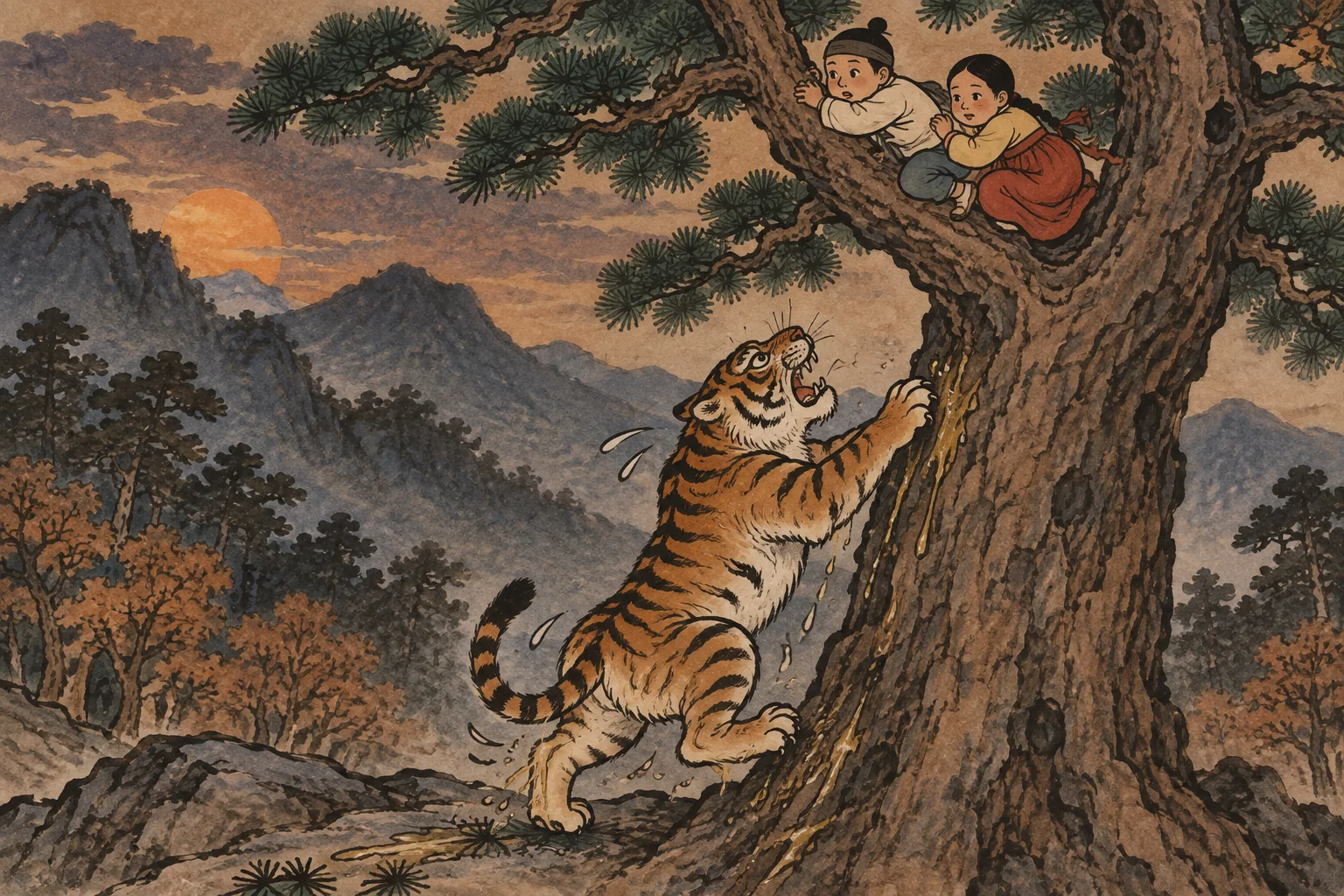
Once outside, they did not come back. They climbed an old pine tree and hid above the ground. The tiger waited for them, then went looking. It found both children in the branches.
How had they climbed so high? The boy said they had borrowed oil from a neighbor and rubbed it on the trunk. The tiger tried the same thing. Its paws slipped. It fell back, then tried again.
But the trick could not keep it below forever. The tiger struggled upward until the children could see it coming near. There was no higher branch that could take them safely out of its reach.
They called to heaven. If they were meant to live, they asked for a new rope to be lowered. If they were meant to die, let it be an old one.
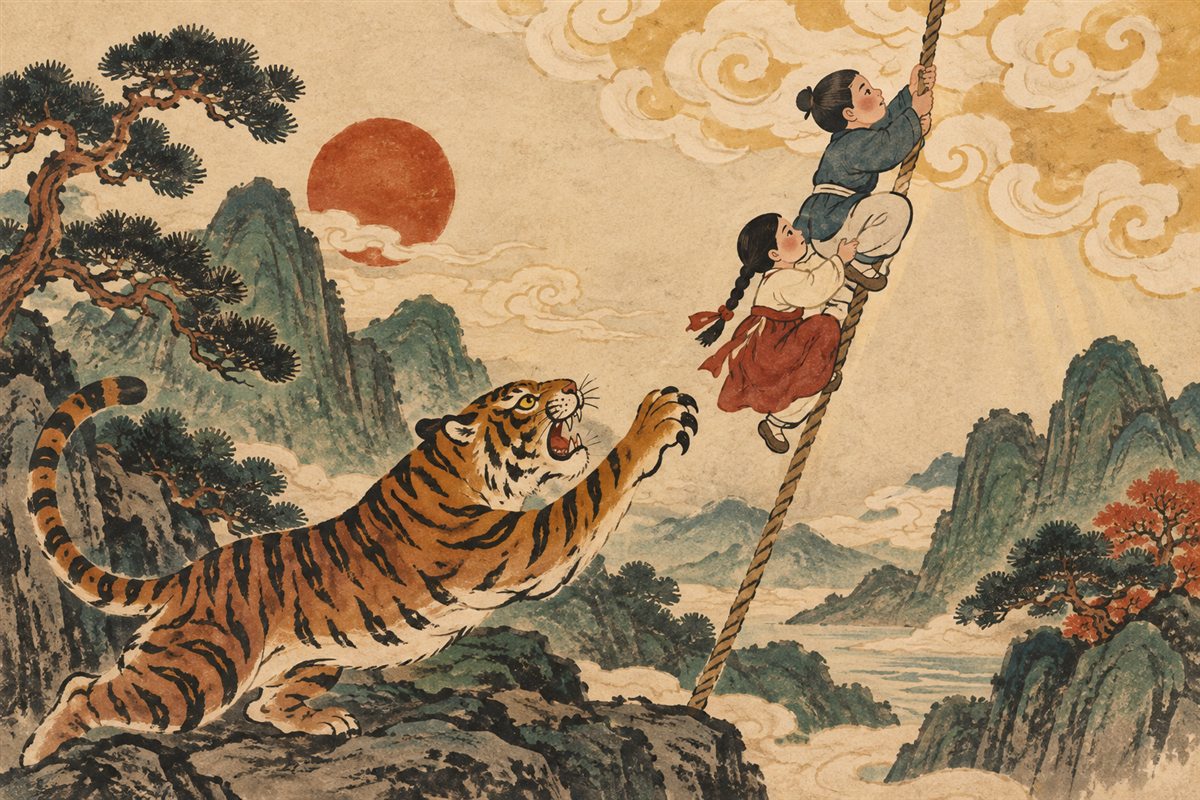
A new rope came down. The children caught it and climbed away from the tree. The tiger reached the place they had been and watched them rising beyond it.
It made the same prayer. A rope descended for the tiger too, but this one was old. The tiger began to climb. The rope broke beneath its weight, and it fell to its death.
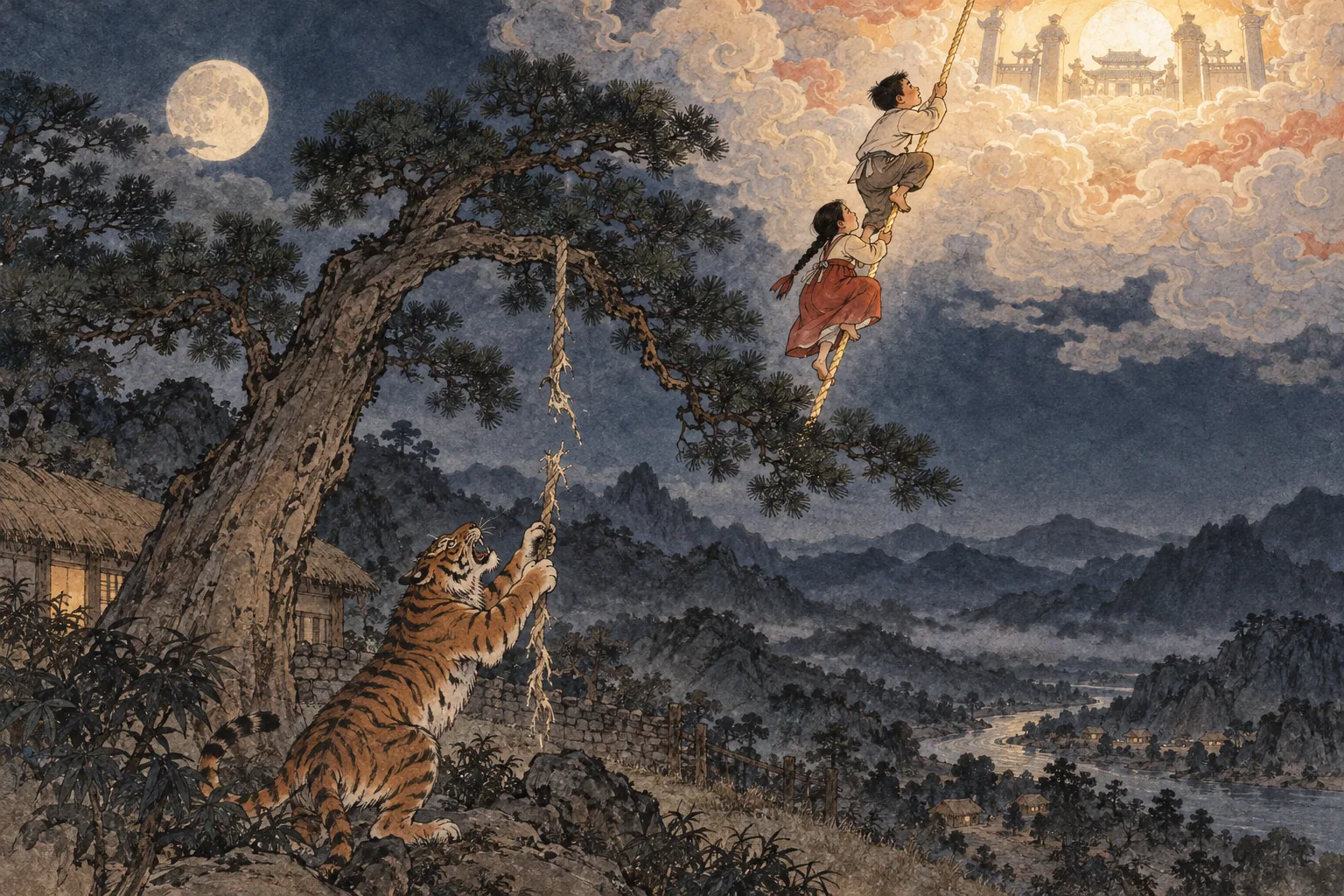
The siblings reached the heavens. The girl became the Sun, and her brother became the Moon. Above the world where they had been hunted, the two took their places in the sky.
Korean Context in This Story
Often called Haenim-dalnim, “the Sun and Moon,” this tale combines a frightening visitor at the door with a chase that ends in the sky. Children can join in with the repeated demands and the siblings’ prayer. Many Koreans remember rice cakes rather than red-bean porridge, or a tiger wearing the mother’s clothes. Some versions also explain red sorghum stalks or why people cannot look directly at the Sun. Read about patjuk →
A Closer Look
A promise that becomes less trustworthy with every hill
Each bowl of porridge seems to buy the mother a little more road. Repetition changes that hope into dread: the tiger can appear again, while the food can only run out. When it reaches the children’s door, it uses a different kind of promise, claiming to be someone they already trust. Their questions about voice and hands show that recognition is something they have to work at.
The children’s escape reverses the arrangement. Their mother had to answer the tiger’s demands; now the boy supplies an explanation that makes the tiger waste time on a slippery tree. Yet cleverness cannot carry them all the way to safety. The two ropes give the ending its final contrast: the children rise on a new one, while the tiger’s old one breaks. Their places in the sky turn a story about an endangered household into an account of the world above it.
Read next: The Tiger and the Dried Persimmon also starts with a tiger outside a house. There, knowing less than a child makes it ridiculous; here, the children must survive the danger it brings.
How Other Tellings Change the Story
Compare the food, the disguise, and the ending
The left column follows Lee Myeong-bun’s Sangju recording. The right describes features in the Academy of Korean Studies survey, rather than a second individual recording.
| Moment | In this telling | In the survey’s account |
|---|---|---|
| The mother’s journey | The tiger demands red-bean porridge at successive hills. | Rice cakes begin a series of demands. |
| At the door | The tiger explains away its strange voice and hands with claims about weaving. | A third, infant child changes how the tiger gains entry. |
| In the sky | The girl becomes the Sun and the boy the Moon. | The boy first becomes the Sun, then exchanges places with his sister. |
The final arrangement in the sky can therefore be the same even when the route to it differs. The exchange adds another scene between the siblings after their escape; this recording lets the ascent itself carry the ending. Remembering the exchange from another book does not mean you have misremembered the whole tale.
Versions and Sources
Read about this telling and other versions
The main story follows Lee Myeong-bun’s 1981 Sangju recording: two children, red-bean porridge, the visitor’s explanations about weaving, the toilet excuse, an old pine and the girl becoming the Sun. The mother’s death is less graphically described here. This record does not describe a clothing disguise or a well, and neither is added.
The Academy of Korean Studies overview describes other forms, including a third child, the mother’s clothes, a sorghum field and an exchange of the Sun and Moon. Those details belong to different tellings.