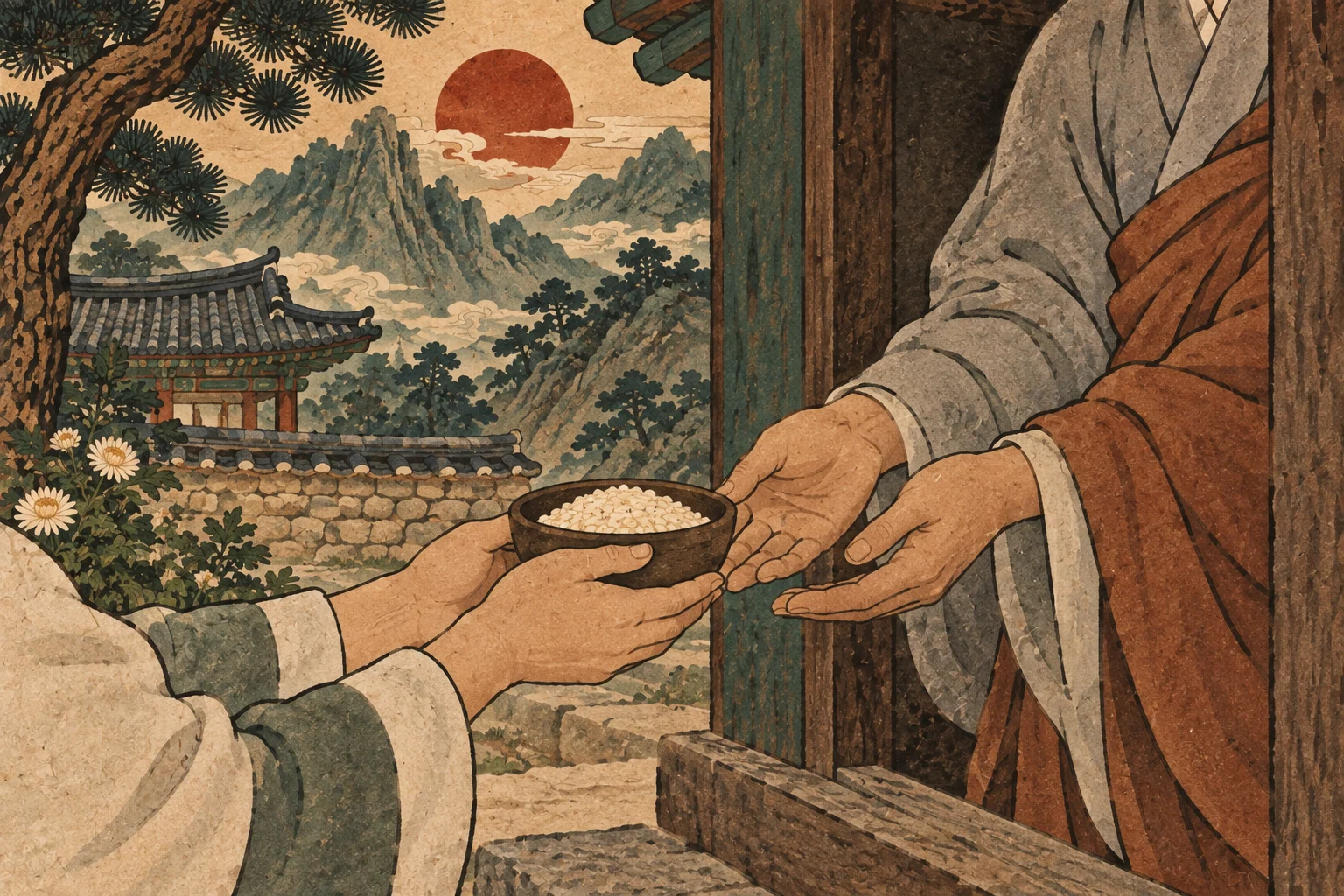
Siju: Giving an Offering to a Buddhist Monk or Temple
시주
A gift of food, money, or goods to a Buddhist monk or temple. In the Jangja Pond legend, sharing rice sets a daughter-in-law apart from her household.
What Does Siju Mean?
Siju (시주) is a Buddhist term for materially offering money, food, or other goods to a monk or temple; it can also refer to the person who makes the offering.
Siju in the Jangja Pond Story
In the Jangseong telling, the daughter-in-law secretly gives rice to a monk after seeing her father-in-law mistreat him. The monk then warns her to flee uphill with her baby. Her decision to feed a stranger separates her from the rest of the household before the flood separates their fates.
The storyteller identifies the hidden rice container as an earthenware jar. See the related guide to onggi, a broad category of Korean earthenware vessels.
A Handful from the Jar, a Gift Outside the Door
Rice passes through two very different encounters in the legend. The wealthy man points to a store beneath his floor and limits what the monk may take. His daughter-in-law measures out rice herself and follows the visitor outside. The contrast is about how the gift is made as well as how much is given: one exchange ends in threats, the other begins with a respectful approach.
The earthenware jar makes the stored wealth easy to imagine. It holds food that could be shared, while its position under the floor keeps that abundance within the house. Carrying rice out crosses that household boundary. The daughter-in-law’s action becomes the turning point before the monk ever gives his warning.
Another Story, Another Offering
Simcheong also links a Buddhist offering with a family’s crisis, but its rice serves a different plot. Her father promises three hundred seok to a temple in hope of recovering his sight. The scale of that vow makes it impossible for the poor household to fulfill through ordinary earnings. Reading the two stories together helps separate a shared term from a shared outcome: rice can express generosity in one tale and become an unbearable obligation in another.
Sources
- Academy of Korean Studies, Encyclopedia of Korean Culture: Siju (meaning and documented uses of the term).
- Korean Oral Literature Compendium, “Andong Village Jangja Pond Legend,” POKS.GUBI.GUBI.1_13741 (the selected use of rice offering in this telling).